Can African Wild Dogs Be Domesticated? Here’s What the Science Actually Says
Can African wild dogs really be domesticated? We break down the science, from genetics to conservation status, to discover what makes painted wolves truly wild.
If you’ve ever fallen down a wildlife rabbit hole and landed on footage of African wild dogs – all satellite-dish ears, abstract-art coats, and chaotic pack energy – you’ve probably had the thought “Could one of these ever be a pet?”
Honestly, it’s a fair question, and one that the internet loves to debate.
The answer, however, is a firm, conservation-backed, biology-supported no. Here’s the full picture, because the why is genuinely fascinating.
Efficient Predator
First, What Even Is an African Wild Dog?
Before diving into domestication, let’s set the stage – the African wild dog (Lycaon pictus), also known as the painted wolf or painted dog, is not your typical “dog” in the way most people imagine. While grey wolves, coyotes, domestic dogs, and jackals all fall under the Canis genus, African wild dogs stand alone as the sole surviving members of the Lycaon genus – meaning crossbreeding with Canis species is simply impossible.
As hunters, they are nothing short of extraordinary. With a kill rate estimated between 60 and 90 percent – outperforming even lions – they are endurance athletes of the savanna, chasing prey at speeds up to 45 mph, relying solely on flawless pack coordination. In short: these are not creatures built for the couch.
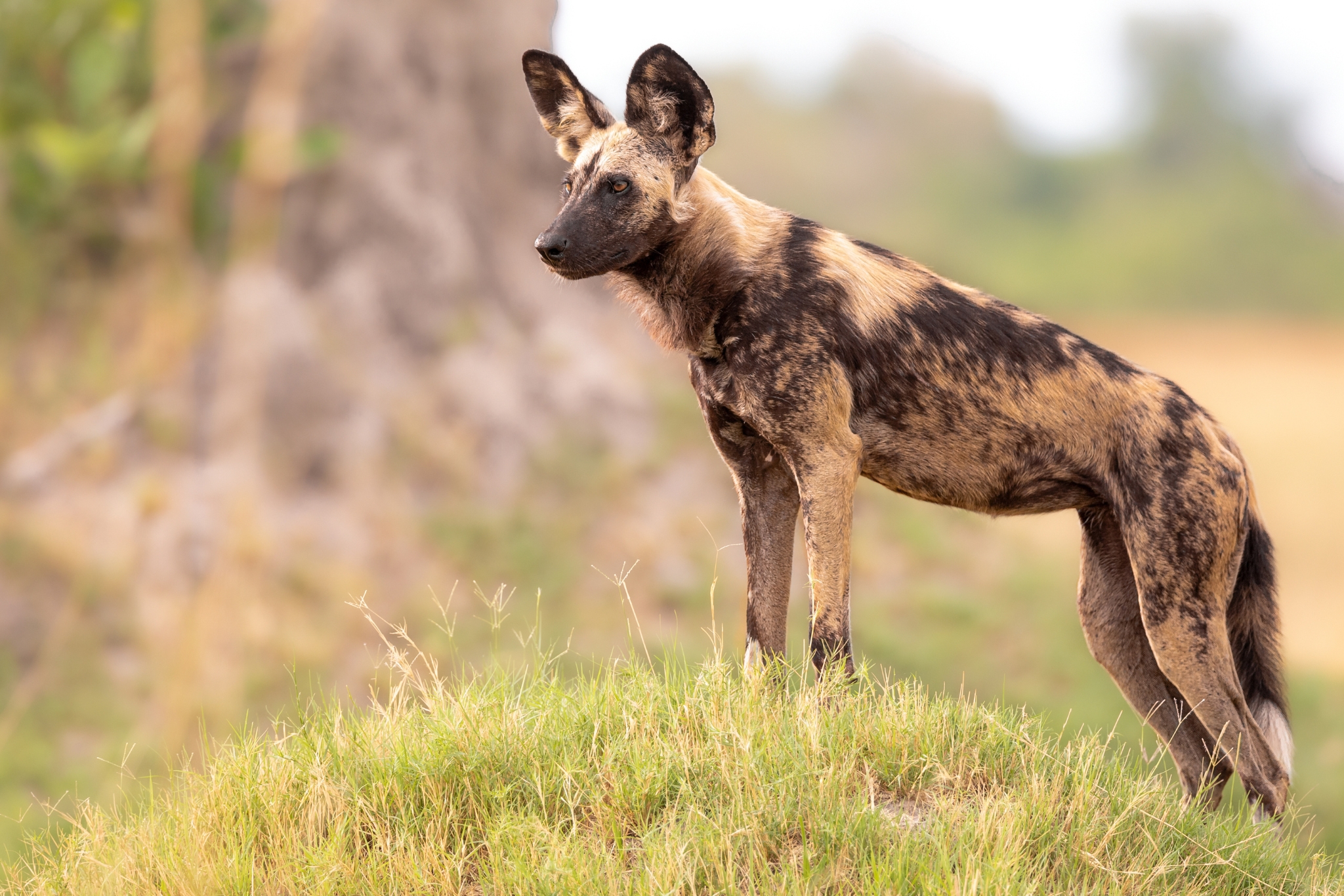
Their scientific name literally translates to “painted wolf” — a nod to their mottled coats of black, brown, yellow, and white. And every single individual has a unique pattern, making identification surprisingly easy for researchers.
The Domestication Question
They Are Genetically Incompatible With Domestication
Here’s the core issue that most people overlook – the genetic divergence between African wild dogs and domestic dogs occurred millions of years ago. While domestic dogs and grey wolves share a relatively recent common ancestor, African wild dogs branched off far earlier, making them an entirely separate and distinct lineage within the Canidae family.
Although they share a common ancestor with wolves from a few million years ago, their genetics are fundamentally incompatible, so interbreeding with any other canids simply isn’t possible. The selective crossbreeding that produced every domestic dog breed we know today simply cannot be replicated with painted wolves.
Dog domestication was a slow, multigenerational experiment in trust and adaptation. Wolves were gradually habituated to human presence over thousands of years. African wild dogs, by contrast, have had minimal interactions with humans – leaving no evolutionary foothold for domestication to take root.
Their Social Structure Is Irreproducible in a Home Environment
African wild dogs are not solitary or even small-group animals. Packs can consist of over 30 individuals, though 10 to 15 is more common.
At the helm is the alpha pair – the primary breeders – but unlike many other animal societies, wild dog packs exhibit a remarkable culture of altruism where every pack member participates in hunting, shares food, ensures that pups and weaker members are fed, and injured individuals are cared for collectively.
Reproduction itself depends on this intricate social web, which includes separate male and female hierarchies. Even minor disruptions, like introducing a new member, can have catastrophic consequences – lessons that captive breeding programs have painfully learned.
Removing an individual from its pack doesn’t just stress it; it dismantles the very framework of its psychology and social identity. No domestic pet setting, no matter how well-intentioned, can replicate the dynamics of 15 to 30 related individuals roaming 40,000 square kilometers of savanna.
Built to Hunt, Not to Cuddle
Painted dogs have only 4 digits on their front feet – a trait that diverged from all other canids millions of years ago and is thought to allow this predator to run farther and faster while chasing prey.
These are endurance specialists, designed to chase down prey, not fetch a tennis ball.
Their anatomy is equally optimized for survival: powerful jaws with molars built to shear meat and crush bone, and senses – sight, smell, and hearing – that rival any predator on the savanna. They’re large, rounded ears, lined with muscles, swivel like radar dishes to detect the faintest sound. Every aspect of their body is tuned for life in the wild, not for a quiet afternoon in a suburban backyard.
What About Taming? Isn’t That Different From Domestication?
Yes – taming and domestication are not the same thing, and it’s worth making the distinction.
Taming is about habituating an individual wild animal to human presence. Domestication, by contrast, is a multigenerational genetic transformation of a species. For African wild dogs, neither is realistic – or ethical.
Attempts to tame painted wolves have consistently failed. These animals are naturally wary of humans and of any creature outside their own pack.
In short, African wild dogs cannot be domesticated in any practical or ethical sense. Their complex social systems, reproductive biology, temperament, vulnerability to disease, and conservation status make taming unsafe and true domestication impossible.
The Conservation Reality Check
Even if we ignore the biological hurdles, there’s an overriding ethical barrier: African wild dogs are Endangered, with only around 1,400 mature individuals remaining in the wild.
Keeping them as pets is illegal in many regions due to their protected status and the species has been listed as Endangered on the IUCN Red List since 1990.
These animals face serious threats, including habitat fragmentation, human-wildlife conflict, and disease. Viruses like canine distemper – often spread by domestic dogs – can decimate entire packs. The cruelest irony? Our own pet dogs are among the greatest threats to their survival.
So What Can You Do Instead?
But there is some good new – you don’t need a painted wolf in your backyard to admire these incredible animals. Supporting organizations like Painted Dog Conservation helps fund research, vaccination programs, and habitat preservation.
Ethical, low-impact safari tourism in places like Botswana’s Okavango Delta or Zimbabwe’s Mana Pools not only enriches visitors but also creates financial incentives to protect these canids.
Seeing a pack in the wild – watching them “sneeze-vote” before a hunt, observing adults step back so pups eat first, or trailing them through the golden-hour bush like living abstract paintings – is an experience that renders the very notion of domestication not just impossible, but profoundly unnecessary.
Some Things Are Meant to Stay Wild
These are a lineage millions of years in the making, never part of human domestication, genetically incompatible with it, and currently struggling to survive in the wild. The most meaningful way to honor them is by protecting the habitats they depend on – and by admiring them from the respectful distance they demand.
Some things are simply too extraordinary for the living room.