8+ Reasons Your Horse’s Hay Should Never Run Out And the Research to Back It Up
An empty hay feeder can trigger ulcers, colic, stress, and more. Find out 8+ reasons why your horse’s hay should never run out — and what the studies actually say.
- What Is Free Choice Forage?
- The Horse’s Digestive System Was Built for Constant Forage Intake
- Hindgut Health and Microbiome Stability
- Laminitis, Insulin Dysregulation, & the Case for Appropriate Forage Selection
- Behavioral and Psychological Benefits: The Underappreciated Side of the Science
- Forage and Equine Respiratory Health
- Body Weight, Condition, & the Self-Regulation Question
- Practical Strategies for Implementing Free Choice Forage
- Work With Your Horse’s Biology, Not Against It
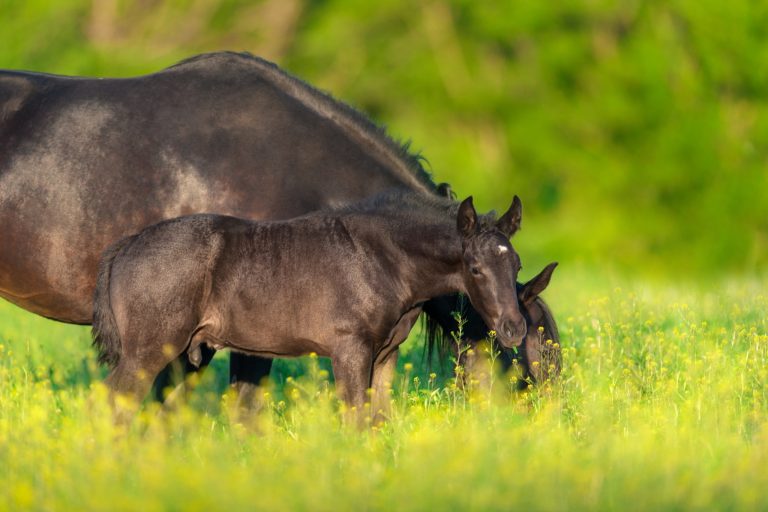
If you’ve ever watched a horse happily grazing in a pasture, you’ve seen exactly how nature intended horses to eat. Long before feed rooms, hay nets, and scheduled meal times, horses evolved as roaming grazers, spending 16 to 18 hours a day slowly moving across the landscape and nibbling small amounts of forage almost continuously.
Modern horse management, however, often looks very different. Many horses are fed just 2 or 3 times a day, leaving long stretches with nothing to eat in between.
While this approach is common, research continues to show that it doesn’t align with how the equine digestive system was designed to function.
That’s why more horse owners, veterinarians, and equine nutritionists are embracing the concept of free choice forage—which simply means providing horses with continuous access to hay or pasture so they can eat when nature tells them to, and not just when the feed cart arrives.
In this article, we’ll take a closer look at the science behind free choice forage and explore how it can support your horse’s digestive health, mental well-being, behavior, and long term overall health.
What Is Free Choice Forage?
Free choice forage, sometimes called ad libitum forage, simply means giving horses continuous access to hay, haylage, or pasture so they can eat throughout the day as nature intended.
Instead of waiting for scheduled feeding times, horses are able to regulate their intake according to their own needs and natural grazing patterns.
This approach differs greatly from more traditional feeding programs, where horses receive set amounts of forage only once or twice a day. While convenient for people, these schedules can leave horses with long periods of time without access to forage—something their digestive systems were never designed to handle.
The Horse’s Digestive System Was Built for Constant Forage Intake
To understand why free choice forage is so important, it helps to understand how the equine digestive system works. Unlike cattle and other ruminants, horses are hindgut fermenters with a relatively small stomach that holds only a small percentage of their total digestive capacity.
One of the most important things to understand is that a horse’s stomach produces acid around the clock, regardless of whether the horse is eating.
In a natural grazing environment, this constant acid production is balanced by the near continuous intake of forage. As horses chew, they produce saliva, which acts as a natural buffer and helps protect the stomach lining from excessive acidity.
Problems can arise when horses go for extended periods without access to forage. Without a steady supply of feed and saliva to help buffer stomach acid, the stomach can become more vulnerable to irritation and ulcer formation.
That’s why veterinarians and equine nutritionists generally recommend minimizing long gaps between forage intake whenever possible.
Research has consistently shown a strong association between restricted forage access and higher rates of equine gastric ulcers:
- Studies have found that gastric ulceration is extremely common in performance horses, particularly those whose feeding schedules differ significantly from natural grazing behavior.
- Researchers have also demonstrated that even relatively short fasting periods can contribute to measurable changes within a horse’s stomach.
The takeaway is simple: the equine digestive system was designed for a near continuous intake of forage.
The closer we can align our feeding practices with that natural pattern, the better we can support our horse’s overall digestive health and function.
Hindgut Health and Microbiome Stability
The benefits of free choice forage extend well beyond the stomach. The hindgut—which includes the cecum and large colon—is where horses ferment fiber and extract a significant portion of their energy.
This region is home to a vast and complex community of microorganisms that work together to break down forage and support overall digestive function.
Like any ecosystem, the hindgut microbiome thrives on consistency. Irregular feeding schedules, sudden dietary changes, and extended periods without forage can disrupt this delicate balance and increase the risk of digestive upset and other gastrointestinal issues.
Long gaps between meals can also encourage horses to consume their forage more quickly when it finally becomes available. This “feast or famine” pattern is very different from a horse’s natural grazing behavior and can create digestive conditions that are less supportive of a stable, healthy hindgut environment.
Research suggests that horses with continuous access to forage tend to maintain a more stable hindgut environment and, in turn, support a healthier, more diverse microbial population. This growing understanding of microbiome diversity highlights it as an important indicator of digestive health, resilience, and overall well-being in horses.
In simple terms, a steady supply of forage helps maintain the kind of consistent digestive environment the equine hindgut was naturally designed to function in.
Laminitis, Insulin Dysregulation, & the Case for Appropriate Forage Selection
A common concern horse owners raise about free choice forage is the risk of laminitis—a painful and potentially serious condition affecting the hoof laminae—especially in horses with equine metabolic syndrome (EMS) or insulin dysregulation (ID).
This is a valid concern, but it doesn’t really argue against free choice forage—it just influences the type of forage that’s appropriate for these horses.
In other words, it’s not about limiting access to hay, but about being thoughtful and intentional with forage quality.
Research shows that it’s mainly the non-structural carbohydrate (NSC) content of forage—especially water soluble carbohydrates (WSC) and starch—that affects insulin responses linked to laminitis risk.
For horses that are metabolically sensitive, the goal is to provide free access to low NSC hay (typically under 10% to 12% NSC on a dry matter basis) that can still be safely offered without restriction.
|
Even for horses that are prone to metabolic issues, going long periods without forage isn’t safe solution. Research from the Waltham Centre for Pet Nutrition suggests that fasting can actually make insulin regulation worse in some horses, since the rebound spike after a long gap may be more problematic than a steady intake of low NSC forage.
For easy keepers or horses with metabolic concerns, the answer isn’t removing free access to forage—it’s refining the approach. That means:
- choosing low NSC forage
- using slow feeder hay nets to extend eating time and naturally moderate intake speed
- supporting regular movement and exercise
The main takeaway from an equine nutrition standpoint is simple: it’s not the amount of forage that matters most—it’s the quality and composition of that forage.
Behavioral and Psychological Benefits The Underappreciated Side of the Science
Horses without continuous access to forage are more likely to develop stereotypic behaviors—which are repetitive, abnormal actions that are difficult to reverse once they become established and are widely seen as signs of reduced welfare.
Common abnormal behaviors that are linked to forage restriction include:
- Crib-biting and wind-sucking: gripping a solid object with the teeth and swallowing air, often associated with gastric discomfort and frustration
- Wood chewing: destructive chewing of fences, stall doors, and other wooden surfaces
- Weaving: repetitive side to side swaying, often linked to stress or boredom
- Stall walking: continuous circling within a confined space
A review in Applied Animal Behaviour Science found that limited access to forage is one of the strongest environmental risk factors for oral stereotypies in horses. In particular, horses receiving fewer than about 6.5 hours of roughage per day were significantly more likely to develop these behaviors compared to horses with free access to forage.
These behaviors are thought to result from a combination of physical and behavioral factors. Physically, forage helps buffer stomach acid and support digestive comfort. Behaviorally, horses are naturally driven to graze for much of the day, so when that foraging need isn’t met, frustration can build and sometimes be redirected into repetitive behaviors that may continue even after management improves.
Further research has also found that horses showing stereotypic behaviors often have higher stress indicators and elevated baseline cortisol levels. This reinforces that these behaviors aren’t just management quirks—they’re signs of real welfare concerns with measurable physiological effects.
Forage and Equine Respiratory Health
An often overlooked part of forage management is its impact on respiratory health. Horses are obligate nasal breathers, which makes them especially sensitive to dust, mold spores, and other airborne particles commonly found in stored forage.
Equine Asthma Syndrome (EAS)—formerly known as recurrent airway obstruction (RAO) or “heaves”—is a chronic inflammatory respiratory condition commonly seen in stabled horses. Research shows that the type and quality of forage a horse is fed can significantly influence how severe the condition becomes.
Studies from the University of Edinburgh’s Royal (Dick) School of Veterinary Studies have found that haylage and steamed hay produce far less respirable dust and fewer fungal spores compared to dry hay. These reductions are associated with measurable improvements in airway inflammation, including lower inflammatory cell counts in bronchoalveolar lavage (BAL) samples.
The practical takeaway is simple: horses with respiratory sensitivities can still benefit from free choice forage, but the focus should be on low dust options like haylage, steamed hay, or thoroughly wetted hay. This way, you still support continuous forage access while helping to reduce your horse’s exposure to airborne irritants.
Body Weight, Condition, & the Self-Regulation Question
A common concern about free choice forage is that horses will overeat and become obese, but the research shows a more nuanced picture.
Multiple studies on healthy horses with unlimited access to hay suggest that most horses naturally self regulate their intake and don’t eat far beyond their daily maintenance needs.
Multiple studies, including reviews in the Journal of Equine Veterinary Science, found that horses offered free choice hay typically consume about 1.8% to 2.2% of their body weight in dry matter per day—right within the normal recommended range.
The horses most likely to overeat are those coming out of a period of restricted feeding. This is known as compensatory intake, where horses with a history of limitation tend to eat more when forage becomes freely available again. It’s a pattern that suggests restriction itself can sometimes encourage overeating, rather than prevent it..
Practical Strategies for Implementing Free Choice Forage
Implementing free choice forage doesn’t require huge acreage or an unlimited budget. With a few evidence based strategies, it can be practical in almost any setup.
- Slow feeder hay nets are one of the most useful tools in modern horse care. Research shows that small hole nets (around 1.5 to 2 inches) can significantly extend your horse’s eating time, more closely mimic natural grazing patterns, reduce waste, and slow intake without limiting access. One study found that slow feeder nets increased hay consumption time by up to 3 to 4 hours compared to loose hay!
- Multiple feeding stations are especially helpful in group settings. They reduce competition and allow more subordinate horses to eat comfortably without being pushed away.
- Pasture management strategies—such as rotational grazing, track systems, or designated sacrifice areas—help balance continuous forage access with pasture health and laminitis risk management.
- Hay testing is another simple but often overlooked step. Sending forage samples to a lab for NSC analysis gives you a clearer picture of sugar and starch levels, helping you decide which hays are suitable for free access, especially for horses with metabolic sensitivities.
Work With Your Horse’s Biology, Not Against It
The scientific literature is clear and consistent: horses are physiologically, psychologically, and behaviorally designed for near continuous forage intake.
When we move away from that pattern—even with the best intentions—it can come with real consequences, including gastric ulcers, hindgut imbalance, stereotypic behaviors, chronic stress, and a higher risk of colic.
Free choice forage isn’t a luxury or an extra—it’s the foundation of an evidence based feeding approach that aligns with a horse’s natural biology.
The real question for horse owners and managers isn’t whether horses should have continuous access to forage, but how to provide it safely and appropriately for each individual horse.