Are Crocodiles Dinosaurs? The Truth About Earth’s Living Fossils
Crocodiles look like dinosaurs — but are they? Discover the surprising truth about their ancient origins and what really survived the mass extinction.
- What Is a Dinosaur, Exactly?
- So What Are Crocodiles?
- The Ancient Crocodile Lineage
- Are Crocodiles More Closely Related to Birds or Lizards?
- What Survived the Mass Extinction?
- How Are Crocodiles Similar to Dinosaurs?
- The Common Misconception Explained
- Why This Distinction Matters
- Frequently Asked Questions about Crocodiles
- Final Thoughts on these Ancient Reptiles
If you’ve ever watched a crocodile lying perfectly still along a riverbank—ancient, armored, and almost prehistoric in appearance—you might have wondered: is this basically a dinosaur?
It’s a common question in paleontology, and the answer is both simple and genuinely fascinating.
What Is a Dinosaur, Exactly?
Before we can answer whether crocodiles qualify as dinosaurs, we first need to define what a dinosaur actually is—because the term is often used a bit too loosely in everyday language.
Dinosaurs belong to a very specific group of reptiles identified by shared anatomical traits, most notably an upright stance, where the legs sit directly beneath the body rather than extending out to the sides. This group, known as Dinosauria, first appeared roughly 230 to 240 million years ago during the Triassic period.
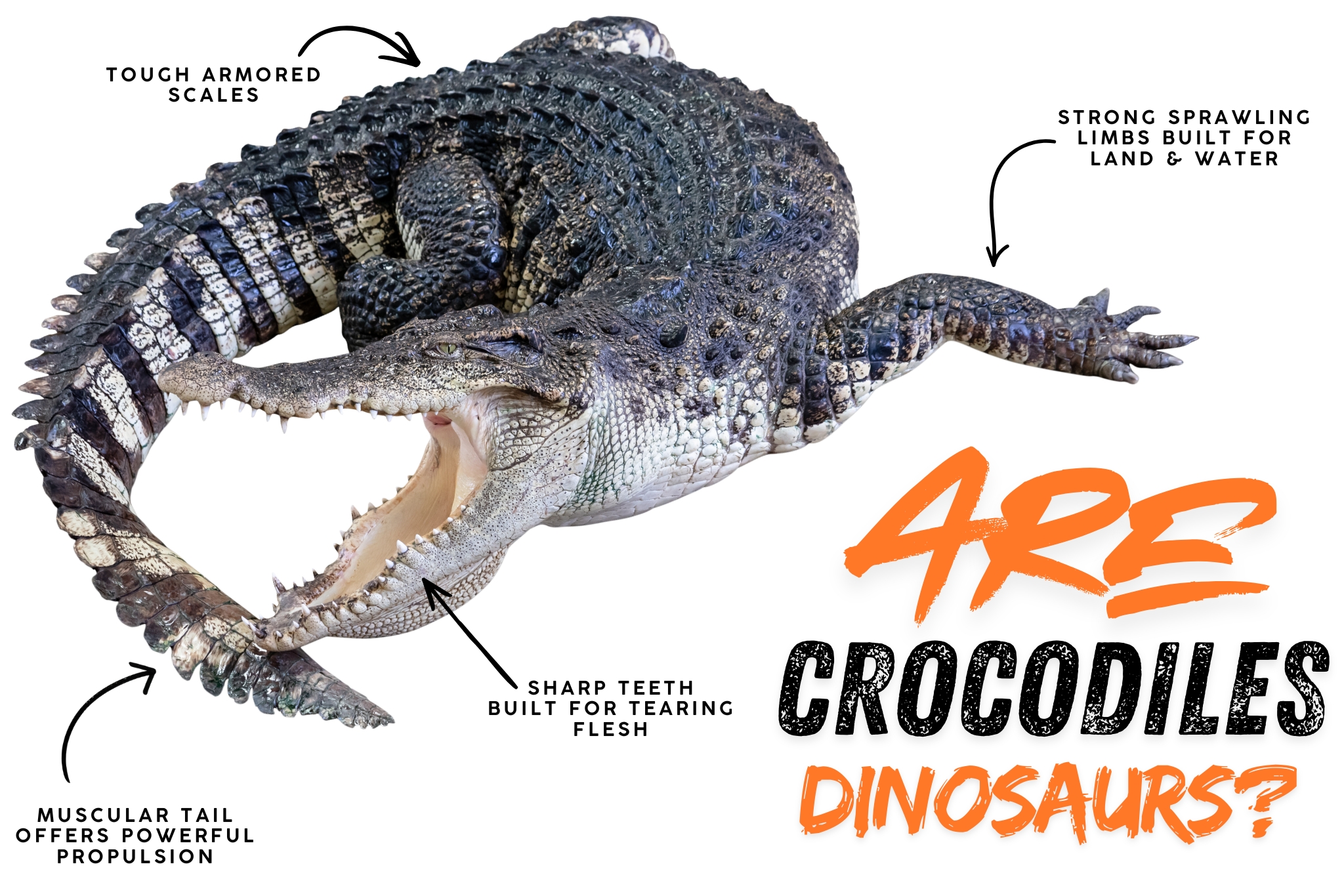
Crocodiles don’t meet this definition. Instead, they have a more sprawling or semi-erect posture, with limbs positioned outward from the body in a fundamentally different structural design from true dinosaurs.
So What Are Crocodiles?
Crocodiles belong to the order Crocodilia, which includes crocodiles, alligators, gharials, and caimans. These animals are part of a broader group called archosaurs—a major reptile lineage that first emerged around 250 million years ago.
Here’s where it gets interesting: dinosaurs are also archosaurs. That means crocodiles and dinosaurs share a distant common ancestor, making them evolutionary cousins rather than members of the same group.
A helpful way to think about it is this: crocodiles are to dinosaurs what chimpanzees are to humans—related through a shared ancestor, but very much separate lineages today.
The Ancient Crocodile Lineage
One of the most remarkable things about crocodilians is just how ancient and relatively stable their lineage is. The early relatives of modern crocodiles—often grouped within a broader category of ancient archosaur relatives—were already well established during the Triassic period, and living alongside some of the earliest dinosaurs.
While dinosaurs went on to diversify into an extraordinary range of forms (and eventually give rise to birds), the crocodilian body plan proved so effective that it changed relatively little over time.
Modern crocodiles still closely resemble crocodilian ancestors that lived around 200 million years ago. Because of this, they’re often referred to as “living fossils,” although scientists use that term carefully—crocodiles have continued to evolve, just not in ways that dramatically altered their overall body structure.
Are Crocodiles More Closely Related to Birds or Lizards?
Most people are surprised to learn that crocodiles are actually more closely related to birds than they are to lizards or snakes.
Birds are the living descendants of theropod dinosaurs—the same group that included Velociraptor and Tyrannosaurus rex. Because both birds (through their dinosaur ancestors) and crocodiles come from the archosaur lineage, they share a more recent common ancestor with each other than either does with lizards, which belong to a completely different reptile group called Lepidosauria.
In other words, your backyard lizard is actually a more distant relative of a crocodile than a sparrow is.
What Survived the Mass Extinction?
Around 66 million years ago, the Chicxulub asteroid impact triggered a mass extinction event that wiped out all non-avian dinosaurs—along with roughly 75% of all species on Earth—but remarkably, crocodilians survived.
Scientists believe several factors likely helped them endure. Their semi-aquatic lifestyle may have offered protection from the most immediate environmental chaos, especially in freshwater systems. As ectotherms (often described as “cold blooded”), they require far less energy and food than warm blooded animals, which would have been a major advantage in a world where ecosystems were collapsing.
They also have a highly flexible, opportunistic diet—able to eat fish, carrion, and almost anything else available. That generalist survival strategy made them far more resilient than many specialized species that couldn’t adapt to rapidly changing conditions.
How Are Crocodiles Similar to Dinosaurs?
While crocodiles are not dinosaurs, the resemblance isn’t just superficial. They share several important traits with their Archosaur relatives:
- Socketed teeth
Both dinosaurs and crocodilians have teeth set in deep sockets, unlike many other reptiles
- Bony armor (osteoderms)
Crocodilians have bony plates embedded in their skin, a feature also seen in several dinosaur lineages
- Four-chambered heart
Crocodilians are unique among most non-avian reptiles in having a fully divided four-chambered heart—something they share with birds and their dinosaur ancestors
- Advanced parental care
Crocodilians are highly attentive parents, guarding nests and sometimes even carrying hatchlings to water. Similar behaviors are also thought to have existed in some dinosaur species
These similarities reflect shared evolutionary ancestry, not coincidence.
The Common Misconception Explained
The confusion between crocodiles and dinosaurs is completely understandable. Crocodiles look ancient and reptilian in a way that naturally feels “dinosaur-like.”
They’re large, heavily armored, toothy predators that have existed for an extraordinary span of geological time. On top of that, popular culture often blurs the lines, loosely grouping all prehistoric looking reptiles under the casual label of “dinosaurs.”
But scientifically, “dinosaur” refers to a very specific group— the clade Dinosauria—defined by clear anatomical and evolutionary traits. Crocodiles fall outside that group, full stop.
Why This Distinction Matters
Understanding the true relationship between crocodiles and dinosaurs is more than just a fun trivia fact—it reshapes how we think about evolutionary history.
Crocodilians represent one of the oldest surviving lineages of large predators, living both on land and in water. They offer a living glimpse into the Mesozoic world not because they are dinosaurs, but because they coexisted alongside them for over 165 million years, survived the mass extinction that ended the dinosaurs, and remain here today.
When you look at a crocodile, you’re not looking at a dinosaur. You’re looking at something arguably just as remarkable: an animal whose core design has been so successful that even the most catastrophic extinction event in the last 250 million years didn’t erase it.
Frequently Asked Questions about Crocodiles
1. Are crocodiles related to dinosaurs?
Yes—crocodiles and dinosaurs share a common archosaur ancestor, making them evolutionary cousins, though they belong to separate lineages.
2. Did crocodiles live with dinosaurs?
Yes—crocodilians and dinosaurs coexisted throughout the Mesozoic Era, from the Triassic through the Cretaceous period.
3. Are crocodiles the closest living relatives of dinosaurs?
Not quite. Birds are the closest living relatives—because birds are dinosaurs (specifically avian dinosaurs). Crocodilians are the next closest living relatives of non-avian dinosaurs.
4. How old is the crocodile lineage?
Modern crocodilians have been around for roughly 95 million years, while their broader archosaur ancestry extends back around 250 million years.
5. Why do crocodiles look prehistoric?
Because they truly are. Their body plan has remained remarkably stable for hundreds of millions of years, reflecting how effective it is as a predatory design.
Final Thoughts on these Ancient Reptiles
Crocodiles are not dinosaurs—but they are ancient archosaurs that share a deep evolutionary heritage with the dinosaur lineage.
They survived the mass extinction that wiped out the non-avian dinosaurs, have changed relatively little in their overall body plan for over 200 million years, and are more closely related to birds than to lizards.
Far from being “just” a prehistoric looking reptile, the crocodile is one of the most extraordinary survivors in Earth’s history.
The next time you see one, you’re not looking at a dinosaur—you’re looking at its living, breathing, deeply ancient cousin.