Why Every Dressage Horse Needs Trail Riding and Hacking Out
Learn why trail riding and hacking out can boost your dressage horse’s fitness, balance, suppleness, and mental well-being for better in-arena performance.
- What Is Hacking Out, and Why Does It Matter for Dressage?
- Physical Conditioning and Cardiovascular Fitness
- Mental Relaxation and Reduction of Training Stress
- Improved Rhythm, Swing, and Throughness
- Exposure to the Outside World and Spook-Proofing
- Joint Health, Hoof Condition, and Soundness
- Strengthening the Horse-Rider Relationship
- Proprioception, Balance, and Self-Carriage
- How to Incorporate Hacking Out Into a Dressage Training Programme
- Final Thoughts: Get Out of the Arena
If your dressage training is happening entirely in the arena, you might be overlooking one of the simplest and most effective tools for building a willing, sound, and mentally balanced horse.
Trail riding and hacking out—often seen as “just a break” from serious training—are increasingly recognised by top riders and equine science alike as essential for long term performance, soundness, and wellbeing.
Whether you’re riding Prix St. Georges or just perfecting your first leg-yields, stepping outside the arena might be one of the best things you can do for your dressage horse.
What Is Hacking Out, and Why Does It Matter for Dressage?
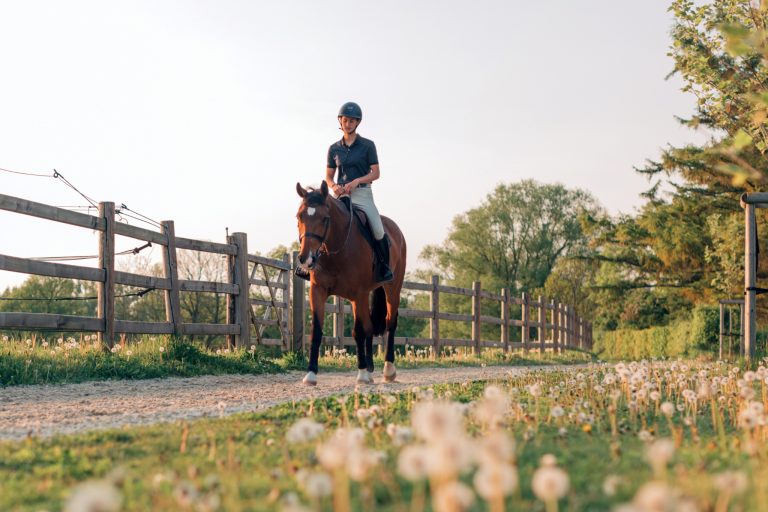
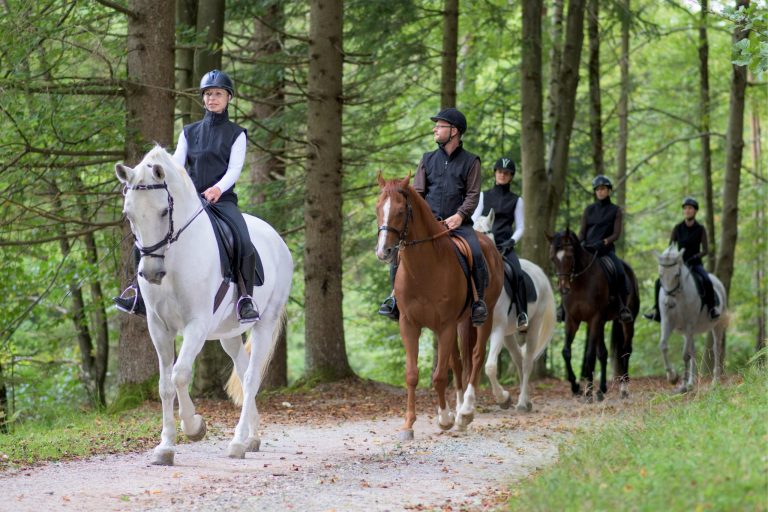
Hacking out simply means riding outside the arena—on trails, bridleways, tracks, quiet country lanes, or across open fields. Unlike structured schooling sessions, it’s typically more relaxed, forward-going work that exposes the horse to changing terrain and environments.
For a dressage horse, whose routine often revolves around precision, collection, and repetitive patterns, this kind of variety isn’t just a nice change of scenery—it’s a genuine physical and mental necessity.
1. Physical Conditioning and Cardiovascular Fitness
Dressage is a highly demanding athletic discipline—but arena work alone doesn’t always provide the sustained aerobic conditioning horses need for peak performance and long term soundness.
- Trail riding at walk and trot builds real cardiovascular fitness in a low-impact, natural way.
- The changing terrain also encourages the horse to engage a wider range of muscles, especially the core, back, and hindquarters that support balance and stability.
- As horses walk and trot up and down gentle inclines, they naturally develop strength in the hind end—directly supporting more powerful, expressive work in the arena.
- Equine sports science consistently shows the value of varied training loads. In particular, hill work is one of the most effective ways to strengthen the gluteal and hamstring muscle groups—key engines for collection, engagement, and advanced movements like piaffe.
PRO TIP: For riders focused on developing true power from behind, steady uphill work can often be more effective than repeating transitions on a 20 meter circle.
2. Mental Relaxation and Reduction of Training Stress
Dressage horses are among the most highly schooled athletes in the equestrian world. The ongoing demands for precision, collection, and constant responsiveness to subtle aids can create mental and emotional pressure over time.
As prey animals, horses also have a natural need to move freely through safe, open spaces. When that need isn’t regularly met, it can show up as tension, resistance, sensitivity to the aids, stable-related behaviors, or a gradual loss of willingness—all of which can interfere with training progress.
Going on train rides offers your horse a valuable mental reset. The change of environment, the chance to move forward freely, and the opportunity to process new sights and sounds all help reduce the accumulation of training stress. Many riders notice a clear improvement in softness, attitude, and overall willingness after regular time outside the arena.
A horse that hacks out regularly tends to return to the arena more relaxed, more willing, and mentally fresher for the work ahead.
3. Improved Rhythm, Swing, and Throughness
One of the most common challenges in dressage horses is tension that blocks the flow of energy through the back—the quality often referred to as “throughness” (or Durchlässigkeit in classical German training).
This tension is frequently linked to too much repetitive arena work and not enough relaxed, forward movement in open space.
Hacking out at a calm, rhythmic walk is one of the simplest and most effective solutions. The walk is the gait most easily disrupted by tension, but it’s also the one that improves most dramatically when the horse is allowed to move freely over varied terrain without restriction.
Riders who hack regularly often notice a clear improvement in their horse’s walk—more natural rhythm, better ground cover, and a looser, more swinging back and hindquarters. That improved relaxation then carries over directly into arena work, helping unlock the suppleness, swing, and elasticity that are so highly valued in dressage at every level.
4. Exposure to the Outside World and Spook-Proofing
A dressage horse that spooks at flags, shadows, birds, or sudden noises isn’t just tricky in the arena—it can become a real safety concern in the warm-up ring as well. Yet many sensitive, highly trained horses become more reactive over time when their world is limited almost entirely to arenas and the stable yard.
Regular exposure to the natural environment—including wildlife, traffic, changing weather, uneven footing, and unfamiliar sights and sounds—builds a level of confidence and desensitization that simply can’t be replicated by circling a few “scary” objects in an arena.
Horses that hack out consistently learn to process and move through new situations without panic. Over time, they develop a quiet, practical confidence and a deeper trust in their rider, both of which are invaluable in the competition environment.
A horse that has calmly navigated woodland trails, crossed streams, and passed farm machinery on a country lane is far less likely to be rattled by a fluttering scoreboard or another unforeseen object.
5. Joint Health, Hoof Condition, and Soundness
Repetitive work on the same arena surface—even high quality footing—creates predictable, repeated loading on the same joints, tendons, and ligaments. By contrast, varied terrain spreads those forces more evenly and encourages a broader range of proprioceptive responses.
Walking and trotting on natural ground such as grass, gravel, or softer types of footing also activates the hoof’s natural shock-absorbing and circulatory mechanisms. Research in equine podiatry suggests that varied footing can support healthier hoof wall quality and stimulate internal structures like the digital cushion and lateral cartilages in ways that uniform arena surfaces simply don’t.
Because natural terrain is inherently uneven and changing, the horse must constantly adjust its balance and foot placement. This ongoing, low level neurological challenge builds body awareness, coordination, and self carriage—all of which are essential foundations for higher level dressage work.
6. Strengthening the Horse-Rider Relationship
Dressage is, above all, a relationship between horse and rider. That partnership is built not only through precise aids and communication in the arena, but also through shared experiences, trust, and genuine enjoyment.
Hacking out together—exploring new routes, navigating different terrain, and encountering the unexpected—adds a layer of trust and connection that an arena alone can’t fully replicate.
Horses that associate riding with variety, freedom, and low pressure experiences tend to be more willing and relaxed when they return to the more demanding work of the arena.
7. Proprioception, Balance, and Self-Carriage
Self carriage—the horse’s ability to maintain balance and frame without constant support from the reins—is one of the defining qualities of advanced dressage. It’s also a quality that can be unintentionally weakened by too much time spent schooling in a predictable, flat arena.
Natural terrain, by contrast, requires constant adjustment. A horse stepping across uneven ground, navigating a slight camber, or carefully finding footing on a chalky slope can’t rely on repetition or routine—it has to stay aware, responsive, and balanced in real time.
This kind of movement engages both the nervous system and the body at once, improving coordination, strength, and proprioception. Riders often find that horses who hack regularly return to the arena carrying themselves with more independence and natural balance—qualities that directly support the lightness and self carriage desired at every level of dressage.
How to Incorporate Hacking Out Into Your Dressage Training
Incorporating hacks and trail rides doesn’t require major changes to your existing training schedule. Even 1 or 2 hacks per week can make a meaningful difference over time:
- Start gradually with young or arena-focused horses: If your horse is new to trail rides, introduce it step by step. Going out in company with a calm, experienced horse can help build confidence and reduce tension.
- Use the hack as active recovery: After a more intense schooling session, a relaxed 30 to 45 minute hack the following day can support muscle recovery and mental reset far more effectively than complete rest in the stable.
- Include some active work: While relaxed walking is valuable on its own, adding periods of trot work—and hill work where available—can significantly enhance your horse’s fitness and strength development.
- Prioritise walk quality: Use hacking time to encourage a truly loose, swinging, four beat walk. Avoid over-controlling your horse; instead, allow it to stretch forward, down, and find its own natural rhythm.
- Make it enjoyable for both of you: The real benefit of hacking comes from the horse experiencing variety, freedom, and low pressure. Resist the urge to school—save the refinement work for the arena and let the ride stay mentally refreshing for both of you.
Final Thoughts: Get Out of the Arena
The dressage arena is where precision and performance is tested—but it’s not the only place where a true dressage horse is developed. Trail riding and hacking out help build the fitness, mental resilience, soundness, and trust that underpin success in the sport.
If you want a horse that is straighter, more through, sounder, and more willing in its work, sometimes the best thing you can do slow down, and leave the area.