This post contains affiliate links. If you make a purchase through one of these links, we may earn a small commission at no extra cost to you.
Horse Wound Care 101
Not every horse injury needs an emergency vet call. Learn how to assess, treat, and monitor minor wounds the right way.
Horses have a way of finding trouble, even when you think you’ve done everything right. Between turnout accidents, fence mishaps, insect bites, and their natural curiosity around anything sharp or unfamiliar, scrapes, cuts, and minor wounds are simply part of owning horses.
While some minor wounds can be managed with basic first aid and careful monitoring, others may look harmless at first but require prompt veterinary attention.
Knowing how to respond calmly and appropriately in those first few minutes can make a big difference between a wound that heals cleanly in a week and one that turns into a costly drawn out infection.
This article covers how to assess a fresh injury, how to determine whether it’s something you can safely manage at home, and the basic steps for cleaning and caring for a minor wound. We’ll also go over the warning signs that mean it’s time to stop searching for answers online and call your veterinarian.
First Things First Stay Calm and Assess the Situation
The first step when your horse gets hurt is to stay calm.
Horses are highly sensitive to the behavior and body language of the people around them, and a panicked approach can make an already stressful situation worse. If your horse becomes more anxious or starts moving around, there’s a greater chance of aggravating the injury—and of someone getting hurt.
Before reaching for the hose, first aid kit, or wound spray, take a moment to observe what’s happening. Spend about 30 seconds assessing the situation from a safe distance and look for a few important warning signs.
1. Where is the wound located?
Wounds around joints, tendons, eyes, or major blood vessels deserve extra caution, even when they appear small on the surface.
Injuries in these areas can involve deeper structures that aren’t immediately visible.
2. How is your horse standing and moving?
Pay attention to weight bearing and overall movement. A horse that won’t put weight on a leg, is noticeably lame with a head bob, or doesn’t want to move at all should be evaluated by a veterinarian promptly, even if the wound itself looks minor.
3. How much is it bleeding?
Some areas, particularly the head and lower legs, can bleed heavily because they have a rich blood supply. A small cut can therefore look much more dramatic than it actually is.
Slow or steady bleeding may be manageable with appropriate first aid, while blood that is spurting, flowing heavily, or rapidly pooling requires immediate veterinary attention.
4. Is anything stuck in the wound?
Check for obvious foreign objects such as pieces of wood, wire, or fencing material. If something is deeply embedded, don’t try to pull it out yourself.
Removing an object can cause significant bleeding or make the injury worse. Contact your veterinarian instead.
First Aid Check
If your horse is calm, standing normally, and bearing weight — and the wound appears superficial with no major bleeding or embedded object — you may be able to begin basic first aid while continuing to monitor the injury closely.
When in doubt, it’s always safer to contact your veterinarian than to risk turning a manageable wound into a more serious problem.
Building an Equine First Aid Kit Before You Need One
The worst time to discover you’re out of vet wrap or can’t find the bandage scissors is when your horse is standing in front of you with a fresh injury. Having a well stocked first aid kit ready to go can make those stressful moments much easier to handle.
Keep the kit somewhere that’s easy to reach, both at home and when you’re traveling with your horse. Don’t bury it underneath saddle pads and equipment in the trailer. You want to be able to grab it quickly when you need it.
Equine First Aid Kit
What Every Kit Should Include
Clean towels and gauze pads — preferably non-stick pads for covering wounds.
Vet wrap and standing wraps — for securing dressings and providing support when appropriate.
Saline solution or a clean squeeze bottle — for gently flushing wounds.
Diluted povidone iodine (Betadine) or chlorhexidine — when appropriate for wound cleaning, used according to veterinary guidance.
Blunt tip bandage scissors — for safely cutting through wraps and dressings.
A digital thermometer — designed for safe rectal use in horses.
A stethoscope — if you’re comfortable using one to check your horse’s heart rate and gut sounds.
Clean disposable gloves — to help keep your hands and the wound clean.
Duct tape — surprisingly useful for reinforcing hoof wraps and securing certain types of bandaging.
Your veterinarian’s phone number, plus a backup emergency clinic number — written down and kept in the kit, not just saved on a phone that may be dead when you need it.
It’s also a good idea to check your kit regularly. Replace anything that’s expired, dried out, used up, or damaged, and make sure everything is still clean and ready to use. A few minutes of preparation now can save you valuable time when an injury actually happens.
Step-by-Step Treating a Minor Wound
Once you’ve determined that the injury appears appropriate for basic first aid, the goal is to:
- Clean the wound
- Control any bleeding
- Protect the area from further contamination
- And keep a close eye on how your horse is doing
If you’re unsure about the depth or location of the injury, it’s better to involve your veterinarian rather than trying to manage it yourself. Wounds involving joints, tendon sheaths, tendons, or bone can look deceptively small while being much more serious underneath.
1. Restrain your horse safely.
- Have someone hold your horse whenever possible, or use safe restraint if you’re working alone and know how to do so.
- Choose a quiet, well lit area where you can work without putting yourself in unnecessary danger.
- Avoid standing directly in a kick zone, especially if your horse is frightened or painful.
The goal is to keep both you and your horse calm and prevent sudden movement from making the injury worse.
2. Gently clean the wound.
- For a superficial wound, gently flush away dirt, hair, and other debris using plenty of clean water or sterile saline.
- A low pressure stream is appropriate for rinsing.
- Avoid blasting the wound with high pressure, which can force contaminants farther into the tissue.
- Don’t scrub directly into the wound with a brush or harsh cleanser!
- If an antiseptic is recommended, use an appropriately diluted product rather than applying concentrated disinfectant to damaged tissue.
- Saline is particularly useful because it’s gentle on healing tissue.
- Strong chlorhexidine solutions and surgical scrubs can damage healthy tissue, so follow your veterinarian’s directions for dilution and use.
3. Assess the wound’s depth.
Once the area is clean enough to see, consider what type of wound you’re dealing with:
- Superficial: the injury appears limited to the skin, with no obvious gaping or exposed deeper structures
- Deep or gaping: you can see or suspect involvement of fat, muscle, tendon, or bone, or the edges don’t come together normally
- Puncture: there’s a relatively small opening that could extend much deeper than it appears, particularly if it’s located near a joint or tendon sheath
Warning
Don’t probe deeply into the wound yourself.
If you’re uncertain about its depth — or if it’s near a joint, tendon, tendon sheath, or bone — contact your veterinarian. These locations can require more thorough examination and treatment even when the surface injury looks minor.
4. Control the bleeding.
- For minor bleeding, apply firm, direct pressure with clean gauze or a clean towel.
- Hold the pressure continuously rather than repeatedly lifting the material to check whether the bleeding has stopped.
- If blood soaks through, add additional material over the top rather than removing the first layer.
- If significant bleeding continues despite firm pressure, or the blood is flowing heavily or spurting, treat it as an emergency and contact your veterinarian immediately.
5. Use an appropriate topical treatment.
After the wound has been thoroughly cleaned, your veterinarian may recommend a suitable wound topical, ointment, or spray. It’s important to use products specifically intended for wound care and follow the label directions or your veterinarian’s instructions.
When it comes to wound products, more isn’t necessarily better. Avoid harsh or irritating substances that aren’t recommended for open wounds, and don’t assume a product made for people is automatically safe or appropriate for horses.
The goal is to keep the wound clean and protected while supporting the body’s natural healing process.
One product worth having in your equine first-aid kit is Power Dust for Horses. It’s a powdered wound care product formulated to support circulation and healthy tissue growth during the healing process.
One of the great things about Power Dust is that it gives you a couple of different ways to use it depending on the wound. For a fresh moist wound, you can sprinkle the dry powder directly over the injury and cover it with a sterile wrap. For a dry or scabbed wound, you can mix it with water and apply it as a poultice.
Don’t forget to always follow the product directions and check with your veterinarian for wounds that are deep, heavily contaminated, near a joint or tendon, or may require sutures.
6. Use bandage when appropriate.
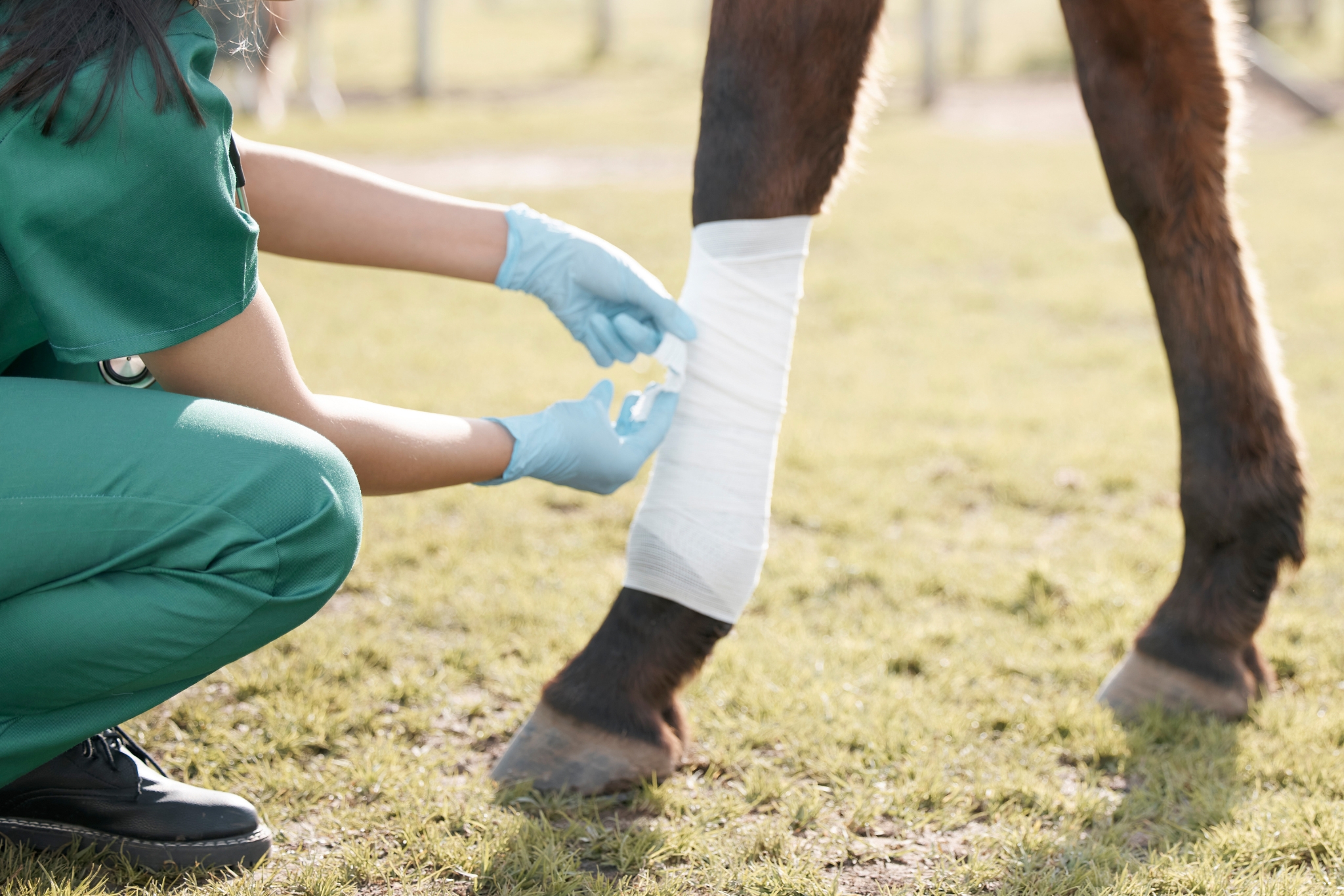
Bandaging can help protect a wound from dirt, contamination, and additional trauma, particularly on the lower legs. Your veterinarian may recommend a non-stick dressing followed by appropriate padding and a protective outer wrap.
If you’re applying a bandage:
- Place a clean non-stick dressing over the wound.
- Add appropriate gauze or padding to protect the area.
- Secure the dressing with an outer wrap using even, controlled tension.
- Avoid wrapping so tightly that circulation is compromised.
- Check the bandage regularly and change it as directed.
- Watch for increasing swelling, heat, pain, or other changes around the bandage.
Bandaging technique matters—a wrap that’s too tight can cause serious tissue and circulation problems, while one that’s too loose can slip and create additional injury.
If you’re not confident applying a limb bandage, ask your veterinarian to demonstrate the technique.
7. Keep the wound clean and protect it from flies.
Wound care doesn’t end when the bandage goes on. Keep your horse in a clean, dry environment and limit exposure to mud, manure, and other sources of contamination. For wounds that remain exposed, appropriate fly control can help reduce contamination and irritation.
Continue checking the wound regularly for increasing swelling, heat, discharge, odor, worsening lameness, or other changes. If the wound isn’t progressing as expected—or your horse’s condition deteriorates—contact your veterinarian rather than continuing to treat it at home.
Most importantly, remember that first aid is meant to stabilize and protect your horse until the injury can be properly evaluated when necessary. It isn’t a substitute for veterinary care when there’s any possibility of deeper damage.
Signs a “Minor” Wound Isn’t So Minor
Even a wound that looks small at first can become a bigger problem if infection develops or deeper structures are involved.
When you’re monitoring an injury at home, make sure you pay attention not only to the wound itself but also to changes in your horse’s movement, temperature, comfort, and overall behavior. If something seems to be getting worse rather than better, it’s time to involve your veterinarian.
Call your veterinarian if you notice any of the following:
1. Increasing heat, swelling, or pain.
Some inflammation can be expected after an injury, but swelling, heat, or soreness that becomes noticeably worse over the next 24 to 48 hours can be a sign of infection or another complication.
2. Abnormal discharge.
Thick yellow or green discharge, especially when accompanied by an unpleasant odor, should be evaluated rather than treated as normal wound drainage.
3. New or worsening lameness.
If your horse becomes lame, stops bearing weight normally, or becomes increasingly reluctant to move, don’t assume the problem is limited to the visible wound.
4. A wound near a joint, tendon sheath, or eye.
These locations deserve prompt veterinary attention because an apparently small wound can involve important underlying structures.
5. A wound that gapes open or won’t stay closed.
Deep or widely separated wounds may require professional cleaning, debridement, or closure rather than continued home treatment.
6. An elevated temperature.
A horse with a fever should be evaluated in context with its other signs, particularly if there is a wound that could be infected.
Don’t rely on a single temperature reading alone—your veterinarian can help determine whether the temperature is abnormal for your horse and situation.
7. Proud flesh begins developing.
Excessive granulation tissue can become a problem, especially with wounds on the lower legs, and may interfere with normal healing. Your veterinarian can determine whether additional treatment is needed.
It’s better to call a little early than a little too late.
A veterinarian can assess structures you can’t see from the surface and determine whether your horse needs additional cleaning, medication, imaging, sutures, or tetanus protection.
When to Call the Vet Immediately (Don’t Wait and See)
Some injuries shouldn’t be treated as minor, even when the wound itself looks surprisingly small. Certain locations and types of trauma can involve serious damage beneath the surface, so it’s important to recognize when home first aid isn’t enough.
Contact your veterinarian promptly—and treat the situation as an emergency when appropriate—if you notice any of the following:
- Severe or uncontrolled bleeding. Spurting blood or bleeding that doesn’t slow with firm, continuous pressure requires immediate veterinary attention.
- A wound near or involving a joint, tendon, tendon sheath, or eye. These areas contain important structures that can be seriously damaged by what appears to be a small wound.
- A deep puncture wound. Punctures from nails, wire, wood, or other objects can penetrate much deeper than the surface opening suggests and may introduce bacteria into sensitive tissues.
- Visible bone, tendon, ligament, or significant tissue separation. These injuries require professional evaluation and may need specialized treatment or surgical repair.
- Sudden, severe lameness. If your horse suddenly refuses to bear weight or becomes severely lame, don’t assume the cause is minor just because you can’t find an obvious wound.
- Colic-like signs after an injury. A horse experiencing significant pain or internal trauma may show behaviors that resemble colic, including pawing, sweating, lying down, rolling, or repeatedly looking at its side. These signs should be taken seriously, especially when they occur after an accident.
- An injury following a major accident. Falls, trailer accidents, collisions, and other significant impacts can cause internal injuries that aren’t immediately visible. A horse that appears relatively normal afterward can still have serious underlying trauma.
When you’re unsure how serious an injury is, contact your veterinarian and provide clear details about what happened, where the wound is located, how much it is bleeding, and how your horse is behaving. If your veterinarian requests them, photos or video can also help with the initial assessment.
Most veterinarians would much rather hear about an injury that turns out to be minor than see a horse several days later after a potentially manageable problem has developed into a serious complication.
When it comes to horse injuries, early advice is almost always better than waiting to see what happens.
Monitoring the Healing Process
Once you’ve cleaned and treated the initial injury, the job isn’t over.
Good wound care also means checking the area regularly and paying attention to how your horse is doing overall. Small changes can be easy to miss when you’re looking at the same wound every day, so consistent monitoring is one of the best ways to catch complications early.
- Check the wound regularly. Look at it whenever you change a bandage, or at least once a day if the wound is left uncovered. Pay attention to changes in color, swelling, discharge, odor, or the appearance of the surrounding skin.
- Watch your horse, not just the wound. Changes in attitude, appetite, water intake, manure production, or willingness to move can provide important clues about how your horse is feeling. A horse that becomes quiet, uncomfortable, stops eating, or shows other unusual behavior deserves closer attention.
- Take photos as the wound heals. Taking a clear picture every few days can make it much easier to see whether the injury is actually getting smaller and healthier. Gradual changes are surprisingly difficult to notice when you’re looking at the wound every day.
- Keep preventive care up to date. Staying current with your horse’s vaccination and parasite control program helps support overall health while the body is recovering. Follow your veterinarian’s recommendations for the appropriate schedule rather than assuming every horse needs the same routine.
Most minor wounds should show noticeable improvement as the days go by. Swelling should generally decrease, healthy tissue should begin filling in the wound, and your horse should remain comfortable and behave normally.
If the injury seems to be getting worse, stops improving, or develops new signs such as increased heat, swelling, discharge, odor, or lameness, contact your veterinarian for guidance.
The Real Goal
It’s not just about how the wound looks on the surface.
It’s about making sure your horse is healing properly underneath — without an infection or deeper complication developing unnoticed.
The Bottom Line
Minor scrapes, cuts, and bumps are simply part of owning horses. While it’s impossible to prevent every accident, having a basic first aid kit, knowing how to clean and protect a minor wound, and keeping a close eye on your horse can make these situations much easier to handle.
The real skill isn’t learning how to avoid every injury, it’s learning how to recognize the difference between a wound that needs some basic first aid and careful monitoring and one that requires a veterinarian right away. Knowing where that line is can prevent a small problem from turning into a much bigger one.
And if you’re ever unsure which side of that line an injury falls on, it’s better to make the call. A quick conversation with your veterinarian can provide reassurance when the wound is minor—or get your horse the treatment it needs before a manageable injury becomes a serious complication.
When it comes to horse care, a few minutes of caution can save you a lot of time, money, and worry later.