Don’t Pee on a Jellyfish Sting And Other Weird Jellyfish Facts You Didn’t Know
From immortal species to Nobel Prize winning proteins, jellyfish are stranger than you think.
And please, stop peeing on stings. Seriously.
- No, Seriously — Do NOT Pee on a Jellyfish Sting
- Jellyfish Are Older Than Dinosaurs
- One Species Is Technically Immortal
- A Group of Jellyfish Is Called a “Smack”
- They Don’t Actually Swim — They Drift
- Some Jellyfish Glow in the Dark
- Jellyfish Don’t Have Brains — But They Still Hunt
- The Box Jellyfish Is One of the Most Venomous Animals on Earth
- They’re Thriving While Other Ocean Life Declines
- The Bottom Line on Jellyfish
If you’ve ever been stung by a jellyfish at the beach, chances are you’ve heard the same piece of advice repeated over and over: “Just pee on it!”
It’s one of the most persistent ocean myths out there. But unfortunately, it’s also one of the least reliable.
Not only is urine unlikely to help a jellyfish sting, but in some cases it can actually make the situation worse.
And that misconception is just the tip of the iceberg. Jellyfish are far more fascinating than their reputation as beach day nuisances would suggest. These drifting marine animals have survived for hundreds of millions of years, possess remarkable biological adaptations, and continue to surprise scientists with what they can do.
Here’s everything you never knew you needed to know about these extraordinary ocean drifters.
1. No, Seriously Do NOT Pee on a Jellyfish Sting
Let’s start with perhaps the most famous jellyfish myth of all: the idea that urine can treat a jellyfish sting.
Despite its popularity in movies, television shows, and beachside folklore, experts agree that it is not a recommended treatment.
The reason is surprisingly simple. Jellyfish sting using specialized cells called nematocysts—which are tiny, venom filled structures that function like microscopic harpoons.
After a sting occurs, some of these nematocysts can remain on the skin and continue to discharge if disturbed. Because urine varies in composition, it can sometimes trigger additional nematocysts to fire, potentially worsening the sting rather than relieving it.
So what should you do instead?
|
The persistence of the urine myth highlights how easily misinformation can spread when it sounds plausible enough. Jellyfish stings are painful, people want quick solutions, and simple remedies often gain traction long before science has a chance to weigh in.
|
2. Jellyfish Are Older Than Dinosaurs
When you see a jellyfish drifting through the water, you’re looking at one of the oldest animal groups on Earth.
Jellyfish have existed for more than 500 million years, meaning they appeared long before dinosaurs ever roamed the planet. Over that immense span of time, they have survived mass extinctions, dramatic climate shifts, and countless changes to the world’s oceans.
Part of their success comes from their remarkable simplicity:
- Jellyfish have no brain, heart, lungs, bones, or blood.
- Their bodies are composed of roughly 95 percent water, yet they have persisted for hundreds of millions of years with a body plan that has changed surprisingly little.
- Rather than relying on complex organs, they use a simple network of nerves and highly specialized cells to navigate their environment, capture prey, and respond to threats.
It’s a reminder that in nature, survival isn’t always about complexity. Sometimes the simplest designs are the ones that endure the longest.
3. One Species Is Technically Immortal
As if surviving for hundreds of millions of years weren’t impressive enough, one jellyfish species has earned a reputation unlike any other.
The Turritopsis dohrnii, often referred to as the “immortal jellyfish,” possesses the remarkable ability to reverse its life cycle under certain conditions.
When they’re faced with stress, injury, or other unfavorable circumstances, this tiny jellyfish can transform its adult cells and return to an earlier developmental stage known as a polyp. This process, called transdifferentiation, effectively allows the animal to restart its life cycle.
Of course, “immortal” doesn’t mean invincible. These jellyfish can still fall victim to predators, disease, and environmental challenges.
However, unlike most animals, they do not appear to have a fixed biological lifespan. This extraordinary ability has attracted significant scientific interest, particularly among researchers studying aging, cellular regeneration, and the mechanisms that allow organisms to repair and renew themselves.
4. A Group of Jellyfish Is Called a “Smack”
Like many animals, jellyfish have their own collective noun—and it’s a memorable one. A group of jellyfish is known as a smack, and large gatherings are also commonly referred to as blooms.
While the term may sound amusing, jellyfish blooms can be anything but funny. Some blooms contain millions of individuals and can stretch for miles across the ocean.
In certain regions, these massive aggregations have clogged industrial water intake systems, disrupted fisheries, damaged aquaculture operations, and altered local marine ecosystems.
Some jellyfish species are capable of reaching truly extraordinary sizes. The Nomura’s jellyfish, found in the waters of Japan and East Asia, can grow to approximately 6.6 feet across and weigh up to 440 pounds. When large blooms of these giants occur, they can create significant challenges for commercial fishing operations, aquaculture facilities, and coastal communities alike.
5. They Don’t Actually Swim They Drift
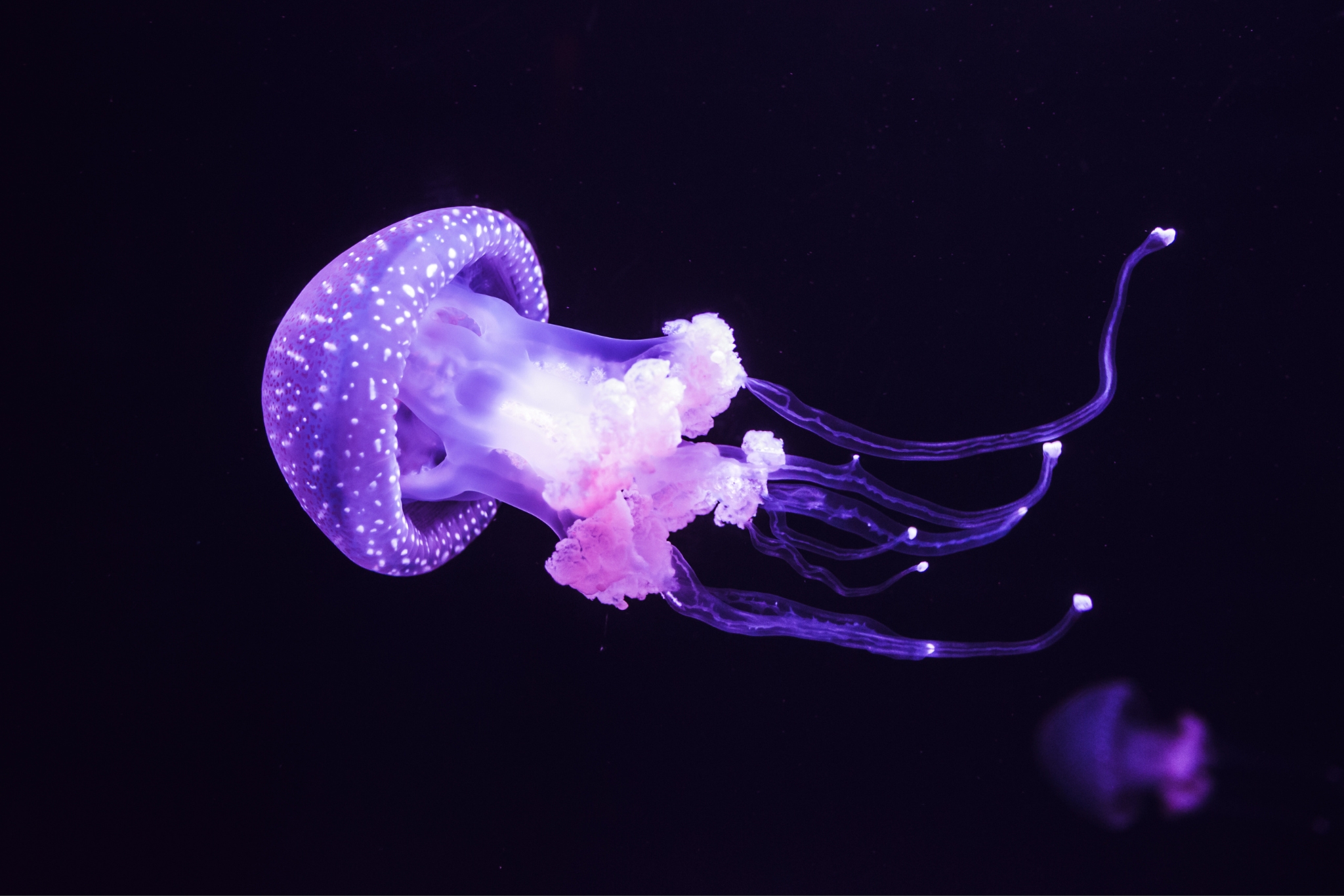
Despite their graceful appearance, jellyfish are not particularly strong swimmers. They propel themselves by rhythmically pulsing their bell shaped bodies, allowing them to move up and down through the water column in search of favorable temperatures, prey, or currents.
However, they have very limited control over where they travel horizontally. For the most part, jellyfish drift wherever ocean currents, tides, and winds carry them.
This is actually why large numbers of jellyfish appearing along a shoreline are rarely an intentional movement. What many people describe as a jellyfish “invasion” is usually the result of environmental conditions.
Certain current patterns, tides, and onshore winds can concentrate thousands—or even millions—of jellyfish and push them toward the coast in a relatively short period of time.
In other words, jellyfish aren’t typically invading the beach—they’re simply going wherever the ocean takes them.
6. Some Jellyfish Glow in the Dark
Bioluminescence—the ability to produce and emit light—is found in many marine organisms, and some jellyfish are among the most spectacular examples. Certain species can generate their own light through specialized chemical reactions, producing mesmerizing blue or green glows that illuminate the darkness of the ocean.
As remarkable as this phenomenon is, its impact extends far beyond the sea. A protein discovered in the crystal jellyfish, known as green fluorescent protein (GFP), became one of the most important tools in modern biological research.
Scientists use GFP to illuminate cells, track disease processes, study gene activity, and observe biological changes in real time.
The significance of this discovery was so profound that the researchers who helped develop GFP for scientific use were awarded the 2008 Nobel Prize in Chemistry. Today, this glowing protein continues to play a critical role in medical and biological research around the world.
In a remarkable example of nature inspiring science, one of the most valuable tools in modern laboratories originated from a jellyfish drifting through the ocean millions of years after its ancestors first evolved.
7. Jellyfish Don’t Have Brains But They Still Hunt
Jellyfish may lack a brain, central nervous system, and traditional eyes, but they are still highly effective predators. Rather than relying on a centralized control center, they use a network of nerves distributed throughout their bodies to detect changes in light, touch, and the surrounding chemical environment.
Some species also possess simple sensory structures called rhopalia, which contain light sensitive organs that help them detect brightness, shadows, and orientation within the water column.
While these structures are far less complex than the eyes of fish or mammals, they provide enough information for jellyfish to navigate their environment successfully.
Their hunting strategy is simple but effective. As they drift through the water with their tentacles extended, small prey such as plankton, fish larvae, and tiny crustaceans may come into contact with their stinging cells. The prey is quickly immobilized and transported toward the mouth, located on the underside of the bell.
Even their digestive system reflects their remarkable simplicity. Food enters through a single opening that serves as both mouth and exit point, creating an efficient system that has helped jellyfish thrive for hundreds of millions of years.
8. The Box Jellyfish Is One of the Most Venomous Animals on Earth
Most jellyfish stings cause temporary pain, irritation, and an unpleasant end to a beach outing. However, box jellyfish are in a completely different category.
Found primarily in the Indo-Pacific region, box jellyfish (class Cubozoa) produce venom that can affect the skin, nervous system, and cardiovascular system simultaneously. In severe cases, stings can lead to cardiac complications within minutes and may be life threatening without immediate treatment.
Unlike most jellyfish, box jellyfish are also active hunters. They are capable of directional swimming at speeds of up to 1.5 meters per second and possess a surprisingly advanced visual system. Each individual has 24 eyes arranged in four clusters, including structures with corneas, lenses, and retinas that can form images.
Despite this complexity, they lack a centralized brain, and scientists are still working to fully understand how their nervous system processes visual information.
Another notable species is the Irukandji jellyfish. Despite its extremely small size—often no larger than a fingernail—it produces a powerful venom that can trigger Irukandji syndrome. This condition is characterized by severe pain, nausea, sweating, elevated heart rate, anxiety, and a profound sense of impending doom. In rare cases, it can be fatal.
Together, these species highlight how dramatically jellyfish biology can vary, from harmless drifters to highly specialized and medically significant predators.
9. They’re Thriving While Other Ocean Life Declines
Here’s the uncomfortable ecological footnote: in many parts of the world, jellyfish populations are increasing.
As ocean temperatures continue to rise, jellyfish are thriving while many fish species are struggling. Overfishing has reduced the number of natural predators, like sea turtles and large fish such as tuna, and nutrient runoff is creating more low oxygen “dead zones.”
Together, these changes are making the ocean a much more welcoming place for jellyfish—and a much tougher one for many other marine animals.
This shift has real consequences for marine ecosystems. Large jellyfish blooms can consume vast amounts of zooplankton and fish eggs, reducing food availability for young fish and disrupting the balance of coastal food webs. In some regions, researchers have raised concerns about ecosystems gradually shifting toward what is sometimes described as a “jellyfish dominated state,” where gelatinous species become more prevalent than traditional fish populations.
Jellyfish are often framed as simple drifters, but their ecological role is anything but insignificant. They appeared long before humans, and given their resilience and adaptability, they are likely to persist long after many other marine species have changed or disappeared.
The Bottom Line on Jellyfish
The next time someone suggests using urine on a jellyfish sting, you’ll know the science doesn’t support it.
And the next time you see a jellyfish drifting through shallow water, it may be worth looking at it differently—not as a nuisance, but as a 500 million year old, bioluminescent, remarkably simple yet highly successful form of life that has shaped modern biology, challenged human infrastructure, and endured through some of Earth’s most dramatic changes.
Respect the smack.