8 Weirdest Animals You’ve Never Heard Of
Nature has been running wild experiments for 3.8 billion years — and some of the results are genuinely unhinged.
- Blob Fish (Psychrolutes marcidus) — But Not How You Think
- Saiga Antelope (Saiga tatarica) — Evolution’s Rough Draft
- Mantis Shrimp (Stomatopoda) — A Living Superweapon With Sixteen Color Receptors
- Aye-Aye (Daubentonia madagascariensis) — Madagascar’s Living Nightmare
- Tardigrade (Phylum Tardigrada) — Immortality with Eight Legs
- Shoebill Stork (Balaeniceps rex) — Ancient, Silent, Terrifying
- Pangolin (Manis spp.) — An Artichoke That Decided to Be an Animal
- Mimic Octopus (Thaumoctopus mimicus) — The Method Actor of the Sea
- Why These Animals Matter Beyond the Weird Factor
If you think you know the animal kingdom because you’ve watched a few nature documentaries, think again. Beyond the lions, monkeys, and giraffes that dominate your social media feed lives an entire shadow cabinet of creatures so bizarre they seem like concept art rejected from a sci-fi film. These animals are real, they exist right now, and they are deeply, magnificently weird.
Let’s meet them.
The Blob Fish (Psychrolutes marcidus) But Not How You Think
Everyone has seen the sad, droopy internet-famous blobfish. But here’s the thing: that gelatinous, melting-face appearance is a lie. In its deep-sea home—under pressure 120 times greater than at the surface—the blobfish looks like a completely normal, vaguely grumpy fish. It’s only when hauled to the surface that the lack of pressure causes its body to catastrophically expand and deflate into the meme you know.
So technically, the weirdest thing about the blobfish is that humans made it weird. Blame physics.
The Saiga Antelope (Saiga tatarica) Evolution’s Rough Draft
Roaming the steppes of Central Asia is an animal that looks like God started drawing a normal antelope, got distracted, and never came back to finish the nose. The saiga antelope’s proboscis is a swollen, drooping, trunk-like snout that hangs down over its mouth like a deflated party balloon. It’s not decorative—that bizarre nose functions as a biological air filter and warming system, heating frigid steppe air before it hits the lungs. It also filters out dust during summer migrations.
Critically endangered and ancient—this creature survived the Ice Age alongside woolly mammoths—the saiga is one of the most urgently important conservation stories you’ve probably never followed.
The Mantis Shrimp (Stomatopoda) A Living Superweapon With Sixteen Color Receptors
You may have vaguely heard of the mantis shrimp, but the reality is far more extraordinary than reputation suggests. This crustacean, which rarely exceeds 12 inches in length, packs a punch that accelerates faster than a bullet—generating cavitation bubbles that briefly reach temperatures comparable to the surface of the sun upon collapse. In controlled settings, it has even been known to fracture aquarium glass.
And that’s before you get to the vision. While humans possess three types of color receptors, mantis shrimp have sixteen. Scientists initially assumed this gave them superhuman color perception. Research later revealed something stranger: they actually process color less discriminately than humans in some respects, but perceive polarized light and ultraviolet patterns invisible to virtually every other creature on Earth. They essentially live in a visual dimension we cannot access.
The Aye-Aye (Daubentonia madagascariensis) Madagascar’s Living Nightmare
The aye-aye is a primate—a distant relative of monkeys and apes—and arguably one of the most visually arresting mammals in existence. Native to Madagascar, it is defined by its oversized, reflective eyes, bat-like ears, perpetually tousled dark coat, and a singularly elongated middle finger. This specialized digit is used to tap along tree bark, detect hollow chambers, and extract hidden grubs with remarkable precision.
Within Malagasy tradition, the aye-aye is often regarded as an omen of misfortune, believed by some to foretell death if it directs that distinctive finger toward a person. As a result, it is sometimes killed on sight—a reality that complicates already challenging conservation efforts. Officially classified as endangered, the aye-aye occupies a rare space: biologically fascinating, culturally significant, and, to many, undeniably haunting in appearance.
The Tardigrade (Phylum Tardigrada) Immortality with Eight Legs
Tardigrades are microscopic, eight-legged, water-dwelling animals that look under magnification like a cross between a gummy bear and a vacuum cleaner bag. They are, without serious competition, the most indestructible animals ever discovered.
They can endure the vacuum of space, survive temperatures ranging from -272°C to 150°C, and withstand radiation levels that would be catastrophic to most forms of life. When conditions turn hostile, they enter a state known as cryptobiosis—expelling nearly all body water, reducing their metabolism to a near standstill, and effectively suspending life itself. In this state, they can persist for decades, reanimating when conditions once again become favorable.
They have been discovered in ocean trenches, Antarctic ice, hot springs, and the Himalayas—thriving in environments that seem fundamentally incompatible with life—and they are almost certainly living on your eyelashes right now.
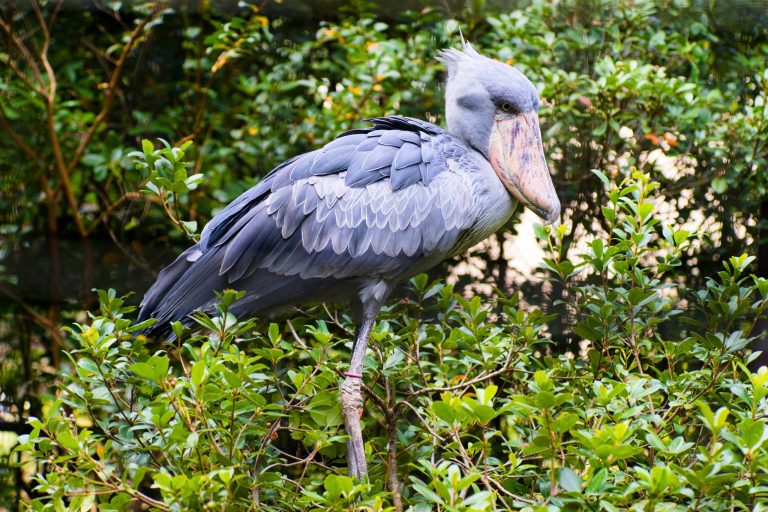
The Shoebill Stork (Balaeniceps rex) Ancient, Silent, Terrifying
Standing up to 5 feet tall with a wingspan exceeding 8 feet, the shoebill stork is a prehistoric-looking bird native to the swamps of East Africa. Its defining feature—a massive, shoe-shaped bill tipped with a sharp hook—is as functional as it is formidable, perfectly suited for ambushing lungfish, monitor lizards, and even young crocodiles.
The shoebill’s hunting style is one of extraordinary patience. It can remain perfectly still for hours, waiting for the precise moment to strike with sudden, decisive force. When encountered by humans, it often fixes its gaze with an intense, almost evaluative stillness. On rare occasions, it will lower its head in a slow, deliberate bow—a gesture some wildlife observers interpret as a form of acknowledgment.
It is not a frequent flier, but when it does take to the air, the sound of its wings has been likened to sound like a machine gun. Researchers have called it “one of the most primeval-looking birds on the planet and fossil records suggest its lineage reaches back millions of years.
The Pangolin (Manis spp.) An Artichoke That Decided to Be an Animal
The pangolin is the only mammal entirely covered in scales, a remarkable adaptation composed of keratin—the same material as human fingernails. When threatened, it curls into a near-perfect sphere, presenting nothing but interlocking armored plates. It has no teeth, relying instead on an exceptionally long, sticky tongue to gather ants and termites with quiet efficiency.
It is also, tragically, the most trafficked mammal on Earth. All 8 species are now threatened or critically endangered, targeted for their scales—used in traditional medicine despite no scientific basis—and for their meat. An animal so inherently defenseless, whose primary strategy is simply to protect itself by curling inward, has been made profoundly vulnerable by human demand.
It is, without question, a species worthy of attention—and of meaningful conservation support.
The Mimic Octopus (Thaumoctopus mimicus) The Method Actor of the Sea
Discovered only in 1998 off the coast of Indonesia, the mimic octopus does something no other animal is known to do: it deliberately impersonates multiple other species, selecting its disguise based on the predator threatening it.
Threatened by damselfish? It impersonates a lionfish—their natural predator—by flattening its body and fanning its arms. Encountered by something else? It buries six arms and waves two in the current, mimicking a venomous flatfish. It has also been documented mimicking sea snakes, jellyfish, and mantis shrimp.
Scientists debate how conscious or deliberate this process is. But the evidence suggests the mimic octopus isn’t just randomly changing shape — it’s making strategic decisions. In an animal with a 3 year lifespan and a brain distributed through its arms, this is either impressive or existentially destabilizing to contemplate, depending on your philosophical inclinations.
Why These Animals Matter Beyond the Weird Factor
It would be easy to treat this list as pure entertainment—a parade of nature’s misfits. But every one of these animals represents an evolutionary lineage stretching back millions of years, solving problems we haven’t even thought to ask about.
The saiga’s nose is a more efficient air filtration system than anything we’ve engineered. The tardigrade’s cryptobiosis mechanisms are actively being studied for applications in medicine and space travel. The mantis shrimp’s visual system has inspired advances in camera and satellite sensor design.
Biodiversity isn’t just ethically valuable—it’s a library of solutions. Every species we lose through habitat destruction, climate change, or poaching is a chapter we’ll never read.
The weirdest animals aren’t nature’s mistakes. They’re its most ambitious experiments.