Can a Bobcat Really Be Tamed? Pet Bobcat Behavior Explained
Curious about pet bobcat behavior? This in-depth guide covers territorial marking, play aggression, social bonding, vocalizations, nocturnal habits, stress signs, and how bobcats differ from domestic cats—everything owners and prospective owners need to know.
- Core Bobcat Behavioral Traits
- Territorial and Marking Behavior
- Hunting and Play Aggression
- Social Bonding and Attachment
- Vocalizations and What They Mean
- Nocturnal Activity Patterns
- Stress Behaviors to Watch For
- Bobcat vs. Domestic Cat: Key Behavioral Differences
- Legal and Ethical Considerations
- Respect the Wild Within
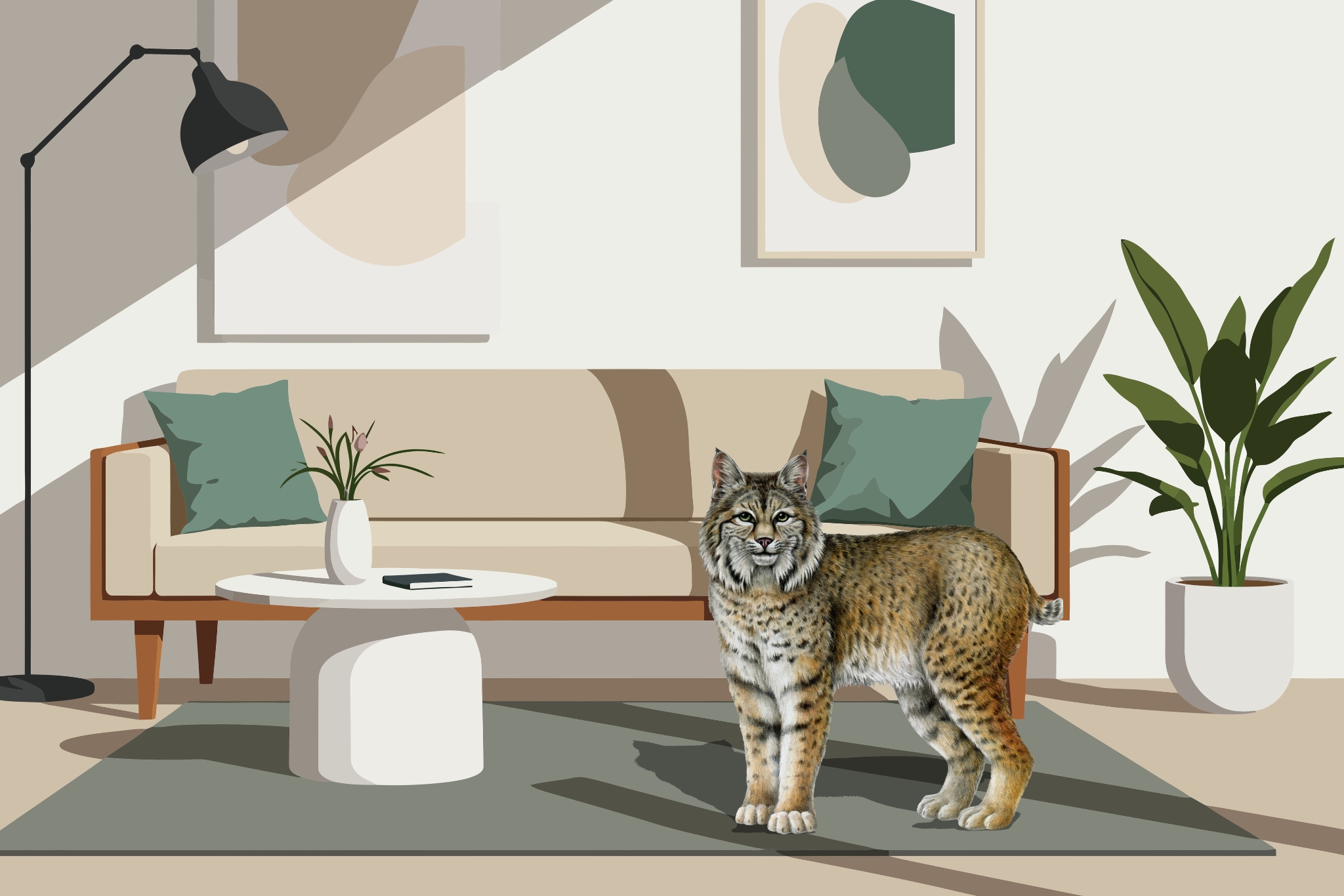
Lynx rufus · North American Wildcat · faunadiscovery.com
The short answer: bobcats can be socialized, but they are not truly domesticated. Domestication takes many generations of selective breeding—the domestic cat has spent thousands of years evolving alongside humans—the bobcat has not
A hand-raised bobcat is a wild animal that has learned to trust—and even bond with—specific people. That bond is real, but it comes with clear limits.
A pet bobcat raised from kittenhood by humans will imprint on its caregivers, seek out affection, respond to its name, and adapt to a a home setting. However, its core instincts remain intact. As it reaches maturity (typically around 1 year of age), when a stranger enters the home, or when it feels cornered, those natural behaviors can resurface quickly.
Understanding that balance—between connection and instinct—is essential when considering what life with a bobcat actually looks like.
Core Bobcat Behavioral Traits
To understand how a pet bobcat behaves, it helps to first understand what a bobcat naturally is in the wild.
Solitary by Nature
Wild bobcats are independent apex predators within their ecological niche. They don’t form packs or seek companionship the way dogs — or even many domestic cats — do. Their natural rhythm is self-sufficient and alone.
Highly Territorial
A wild bobcat’s home range can span 5 to 50 square miles depending on sex, season, and prey availability. That instinct doesn’t disappear in captivity — many will still mark and define their space. Males can be especially territorial and may mark aggressively.
Natural Hunters
Opportunistic predators built for quiet observation and sudden, precise movement. Bobcats hunt rabbits, birds, rodents, and deer fawns. That ambush instinct shows up in play, in interaction, and in how they respond to movement in their environment.
Crepuscular & Nocturnal
Bobcats are most active at dawn, dusk, and through the night. Their eyes are adapted for low-light hunting, and their schedule may not always align with a typical household routine.
All of these traits carry over into a home setting. A pet bobcat isn’t a domesticated version of a wild animal—it’s a wild animal learning to live within a human environment. Understanding that distinction is key to setting realistic expectations.
Territorial and Marking Behavior
One of the most challenging behavioral realities of owning a pet bobcat is urine marking.
Bobcats—particularly intact males—will naturally spray urine to mark their territory. Unlike domestic cat spray, bobcat spray is extraordinarily pungent—described by many owners as somewhere between skunk and concentrated ammonia—and can be extremely difficult to fully remove from porous surfaces like wood, fabric, and drywall.
Sometimes spaying or neutering can help reduce the frequency and intensity, but it does not guarantee that marking will stop entirely. Each individual animal is different, and some level of spraying should be expected.
From a bobcat’s perspective, your entire home is its territory. That means any space—rooms, furniture, doorframes—may be marked, particularly when something in the environment changes. New furniture, unfamiliar visitors, or even shifts in routine can trigger spraying behavior.
Scratching serves a similar purpose. It’s not just maintenance—it’s communication. While scratching posts can help, they rarely replace the instinct to mark multiple surfaces throughout a space. As a result, many owners take extra steps to protect woodwork, upholstery, and other vulnerable areas.
What owners can do
Four practical considerations for life with a territorial bobcat
-
#1
Spay or neuter early. Reducing hormone-driven marking is one of the most effective steps an owner can take — and the earlier it’s done, the better the long-term outcome.
-
#2
Provide designated scratching structures that genuinely satisfy the behavioral drive — not just a single post, but robust, varied options placed throughout the animal’s space.
-
#3
Minimize unnecessary environmental disruptions. New furniture, unfamiliar guests, rearranged spaces — each one can trigger renewed marking. Consistency in the environment is a form of management.
-
#4
Accept that some degree of marking is simply part of the deal. No amount of preparation eliminates it entirely. Owners who struggle most are those who expected otherwise.
Hunting and Play Aggression
This section deserves more attention than it typically gets in online discussions about pet bobcats.
Bobcats are ambush predators. That means their play—especially as kittens and juveniles—closely mirrors real hunting behavior.
They stalk, crouch, and explode into sudden bursts of movement—using their teeth and hind claws in a “bunny kick” motion that is designed to disembowel prey.
When a bobcat kitten does this to a human hand, it can seem cute, harmless, even endearing—but when a 25 pound adult bobcat does it to a human arm, it causes serious injury. An adult bobcat is powerful, with strong jaws and substantial claws, and even playful interactions can result in significant injury.
It’s important to understand that this isn’t aggression in a malicious sense—it’s instinctive, natural behavior. But intent doesn’t lessen the impact. Recognizing how play scales with size and strength is essential to setting safe boundaries and realistic expectations.
Key points for owners
Four essential guidelines for navigating bobcat play behavior safely
-
#1
Never use hands or feet as play objects — ever. What feels manageable with a kitten becomes genuinely dangerous with a full-grown adult. This boundary needs to be established from day one and never relaxed.
-
#2
Provide high-energy outlets that match the animal’s physical needs — large climbing structures, prey-simulation toys, and adequate running space. A bored bobcat directs that energy somewhere, and it is rarely convenient.
-
#3
Recognize the pre-attack posture and disengage immediately. Flattened ears, crouching haunches, a twitching tail tip — these are signals, not invitations. Step back before the behavior escalates.
-
#4
Do not punish the behavior. It will not work, and it may escalate a playful interaction into genuine defensive aggression. Redirection and disengagement are the only tools that reliably help.
Children and unfamiliar adults should never be left unsupervised with a bobcat — regardless of how “tame” the animal seems with its primary owner.
Social Bonding and Attachment
This is where living with a pet bobcat becomes particularly compelling—and where many owners describe something genuinely remarkable.
Hand-raised bobcats frequently form deep, evident attachments to their primary caregivers. They will seek out contact, sleep beside their owners in bed, follow them from room to room, and show clear visible signs of distress when separated. These wild cats recognize and greet their people, develop preferences, and express behaviors that, in many ways, resemble affection.
This bond is real—however, it is also tends to be highly selective. A bobcat may be profoundly attached to 1 or 2 people while treating all others as potential threats. Guests in the home are not always greeted warmly—some bobcats will retreat and hide, while others respond with defensive behaviors like hissing, stalking, posturing, or bluff-charging.
Bobcat owners should understand that this is not a matter of training, but rather a natural expression of the species’ social instincts.
The implication of these natural behaviors is significant for pet owners. Daily life often requires more planning—particularly when it comes to visitors, service appointments, or shared spaces. A bobcat’s comfort zone is typically small—maintaining that sense of security is an important part of responsible care, and attempts to expand it forcibly often backfire.
Vocalizations and What They Mean
Bobcats have a surprisingly complex vocal repertoire, and learning to read it is an important part of cohabitating with one.
Reading your bobcat’s voice
6 sounds — and what each one is telling you
-
Alert
Yowling & Screaming
During mating season or heat, a bobcat’s yowl sounds to many first-time listeners like a human child screaming. Loud, piercing, and wall-penetrating — normal, but a serious issue in any living situation with neighbors.
-
Calm
Chirping & Chattering
A rapid, stuttering sound triggered by watching birds or prey animals. Associated with hunting excitement — generally a positive, calm-ish state.
-
Warning
Hissing & Spitting
Defensive warnings. The animal feels threatened. Back away. Do not attempt to comfort or reach for it. Give it space.
-
Relaxed
Purring
Yes, bobcats purr — on both the inhale and exhale, producing a continuous rumble. A purring bobcat is a contented bobcat. One of the most endearing discoveries for new owners.
-
Relaxed
Meowing
Soft mew-like calls, especially as kittens and in communication with trusted humans. Adults may use quieter contact calls with their bonded people.
-
Alert
Growling
Low, sustained growling is a serious warning. This is not the time for reassurance — it is the time to remove yourself from the situation.
Nocturnal Activity Patterns
If you bring a bobcat into your home, one reality is unavoidable: they’re night owls… or rather, night hunters—you will be awakened at night.
Bobcats are crepuscular hunters by evolution. Their internal clock is tuned to peak activity at dawn and dusk, with significant activity through the night. In a domestic setting, this translates to late-night zoomies, yowling, knocking things off shelves, demanding interaction, and general high-energy chaos at 3 a.m.
Bobcats are crepuscular hunters by nature who are most active at dawn and dusk, and as a result are often lively through the night. In a home, this can show up as:
- Late-night zoomies
- Knocking things off shelves
- Yowling and vocalizing
- Demanding attention and interaction
- General high-energy chaos at 3AM (or other times you’re trying to sleep)
It’s not misbehavior—it’s instinct.
Many owners manage this by giving their bobcat its own dedicated room or enclosure overnight—a large, enrichment-filled space where their cat can burn safely burn energy without destroying the house. Others adjust their own schedules to accommodate this natural rhythm.
Few owners report that their bobcat simply learns to sleep through the night on a human schedule without any structural intervention.
For anyone considering a pet bobcat, it’s important to understand that nighttime activity is part of the package—plan accordingly rather than hoping it will “just go away.”
Stress Behaviors to Watch For
A stressed bobcat is a dangerous bobcat, and stress responses in this species can escalate quickly.
Common stressors
What triggers it
-
Loud, unpredictable noises — construction, parties, fireworks
-
Strangers in the home
-
Changes to routine or environment
-
Other animals, especially dogs
-
Veterinary visits and handling by unfamiliar people
-
Confinement to small spaces
Behavioral signs
What to watch for
-
Excessive hiding or retreating to elevated perches
-
Repetitive pacing or circling
-
Reduced appetite
-
Increased marking
-
Unprovoked hissing or swatting
-
Over-grooming or, conversely, neglecting grooming
Chronic stress in captive wild felids has serious health consequences, including:
- Immune suppression
- digestive issues
- stereotypic behaviors (compulsive, repetitive actions that signal psychological distress)
If your pet bobcat starts showing ongoing signs of stress, the issue isn’t the animal—it’s the environment. Consult with an experienced exotic animal veterinarian familiar with bobcats to evaluate their needs, and focus on adjusting housing, enrichment, and daily routines rather than trying to “fix” the bobcat itself.
Bobcat vs. Domestic Cat Key Behavioral Differences
Many first-time bobcat owners assume their new pet will behave like a domestic cat—but that expectation is misleading. It’s important to clearly understand where domestic cat experience does not apply.
Legal and Ethical Considerations
No honest discussion of pet bobcats is complete without considering the legal and ethical context.
- Legal Considerations – In the United States, pet bobcat ownership is governed at the state level, ranging from outright bans (California, for example) to states that allow ownership with permits. Many states also require USDA licensing, and some counties, cities, and local ordinances impose additional restrictions. It’s essential to research your specific jurisdiction before acquiring a bobcat—not after.
- Captive-Born ≠ Domestic Pet – A common misconception is that a bobcat born in captivity and hand-raised from a young age will behave like a domestic cat. While captive-born bobcats are generally easier to socialize and handle safely than wild-caught adults, their underlying wild instincts remain. They are still species-typical bobcats, not domesticated cats.
- Welfare Considerations – Some animal welfare experts argue that even that even carefully managed pet homes often cannot meet the behavioral and spatial needs of wild felids. Bobcats are designed to hunt, roam, and operate with near-total autonomy. Housing them in a home—or even in a large backyard enclosure—radically constrains those natural behaviors. Whether it is ethical to keep a bobcat in captivity is a question every potential owner should consider seriously.
Respect the Wild Within
Pet bobcat behavior isn’t mysterious—but it is complex, demanding, and frequently misunderstood by people who fall in love with kitten photos and underestimate what adult bobcat ownership actually involves.
Bobcats are remarkable animals—athletic, intelligent, expressive, and capable of forming strong bonds with their chosen people.
Experienced owners describe the relationship with their cats as something that feels unlike anything else—but those relationships are built on a foundation of realistic expectations, serious careful preparation, appropriate infrastructure, and a clear understanding of what a bobcat is: a wild animal living in your home.
If you go in with open eyes, a suitable environment, stable financial resources, and the willingness to adjust your lifestyle around the animal’s needs, pet bobcats can thrive in captivity.
Expecting a large, exotic house cat, however, sets you up for frustration (and failure).
“Know the animal. Respect its instincts. Then decide whether this extraordinary experience is right for you.”
Know the animal
Respect its instincts
Then decide