Why Your Tortoise Keeps Hitting the Glass And How to Fix It
Is your tortoise pacing the glass? Your pet isn’t curious — they’re stressed. Learn why clear boundaries are harmful and how to set up the perfect enclosure.
- The Problem with Glass and Acrylic Enclosures
- Stress Driven Repetitive Behavior
- The Depth Perception Problem
- Reflections Make It Worse
- What Tortoises Need Instead: Opaque, Bordered Enclosures
- Humidity and Ventilation: An Added Bonus of Ditching Glass
- Substrate Depth Matters Too
- Common Species Most Affected
- The Bottom Line on Tortoise Tank Walls
If you’ve ever set up a gorgeous glass terrarium for your tortoise, only to watch it repeatedly press its nose against the walls trying to get out, you’re definitely not alone in that experience—it’s actually one of the most common and well-intentioned mistakes new tortoise keepers make.
Clear glass enclosures may feel like a way to give your tortoise a “room with a view”—but from your tortoise’s perspective, they can be confusing and stressful, turning what looks like openness into an invisible barrier.
The Problem with Glass and Acrylic Enclosures
Tortoises aren’t like fish or small reptiles that can quickly adapt to glass enclosures—they’re actually built for open range movement, and in the wild, tortoises can travel significant distances over the course of a day.
So when a tortoise is placed in a glass tank, they can see beyond the walls but they cannot physically access what they’re looking at. That mismatch creates confusion: the environment appears continuous, yet it really isn’t.
Unlike animals that easily learn the idea of barriers, tortoises don’t interpret transparent glass in the same way. To them, the space beyond still registers as reachable, which can lead to repeated, exhausting attempts to move through it.
Stress Driven Repetitive Behavior
A stressed tortoise will often show it in very visible ways—and one of the clearest signs that clear boundaries are harming your tortoise is wall-pacing or “glass surfing.”
When this happens you’ll see your tortoise repeatedly walking along the glass perimeter, pushing its nose against it, and failing to settle. This isn’t curiosity or exploration—it’s a stress response.
Over time, chronic stress can lead to a range of health issues in tortoises, including:
- Weakened immune function, increasing susceptibility to respiratory infections and shell disease
- Reduced appetite, which may result in long term nutritional imbalances
- Disrupted basking and rest cycles, as stress can interfere with proper thermoregulation
- Shell development issues in younger tortoises, often linked to inconsistent feeding and basking patterns driven by ongoing behavioral stress
One of the most common misunderstandings among new keepers is interpreting this constant wall following behavior as activity or curiosity. In reality, it’s often one of the clearest signs that something in the environment isn’t working for the animal.
The Depth Perception Problem
Tortoises have more complex vision than they’re often given credit for. They can see color, detect movement, and perceive depth—but that depth perception evolved in natural, opaque environments. A transparent barrier disrupts those cues entirely.
When a tortoise looks through glass, it cannot properly interpret distance or solidity. Instead, the world beyond can appear as a continuous extension of its own space. That mismatch taps into its natural drive to explore and move toward open terrain, leading to repeated attempts to move through or along a barrier it cannot understand.
This response is quite different from that of many arboreal reptiles, such as geckos or chameleons, which are more adapted to vertical movement and can more readily learn enclosure boundaries.
Tortoises, by contrast, are ground dwelling roamers—and they’re instinctively oriented toward horizontal travel and expanding territory—which is exactly the kind of movement glass enclosures visually suggest, but physically prevent.
Reflections Make It Worse
Glass and acrylic don’t just create a transparent barrier—they can also produce reflections—and under certain lighting conditions, a tortoise may see a distorted image of itself on their enclosure walls.
Because tortoises do not recognize their own reflection, they may interpret it as another tortoise entering their space. That can trigger territorial or defensive responses, layered on top of the confusion already caused by the invisible barrier.
This combination—an apparent “open” environment that cannot be accessed, plus the perception of a competitor or intruder—can make glass enclosures especially stressful for tortoises over time, both behaviorally and physiologically.
What Tortoises Need Instead Opaque, Bordered Enclosures
Thankfully the solution to all of this is pretty straightforward: give your tortoise a space with solid, opaque walls.
Tortoise tables—which are open topped wooden enclosures—are a favorite among experienced keepers for a reason. When the boundary is visible and clearly defined, the tortoise understands it. No confusion, no endless pacing—just a space that makes sense.
Solid walls send a clear message: this is the edge of your environment. Once that’s established, tortoises naturally shift their focus to the behaviors you actually want to see—like grazing, burrowing, basking, and calmly exploring within their space.
Some popular opaque enclosure options include:
- Tortoise tables made from untreated pine or plywood
- Raised wooden garden beds for larger or outdoor setups
- Custom PVC enclosures with solid paneling
- Indoor-outdoor hybrids with secure, opaque perimeter fencing
Humidity and Ventilation An Added Bonus of Ditching Glass
Glass tanks don’t just create visual confusion—they can also create real airflow issues.
Tortoises—especially Mediterranean species like Greek and Hermann’s tortoises—evolved in dry, well-ventilated environments. A glass enclosure tends to trap humidity and stale air, which can contribute to respiratory infections and even shell rot over time.
Open topped tortoise tables, on the other hand, allow for proper ventilation while still giving you control over substrate depth and temperature gradients.
Making the switch away from glass doesn’t just reduce stress — it often clears up lingering health issues that seemed hard to pinpoint before.
Substrate Depth Matters Too
Pair those solid walls with another essential: deep substrate.
Tortoises are natural burrowers, and in the wild they dig to regulate temperature, hide from threats, and settle in to rest. Giving them at least 4 to 6 inches of a suitable substrate—like topsoil mixed with play sand or coco coir—lets them actually express those instincts.
A tortoise that can burrow is a tortoise that feels secure—and that sense of security makes a real difference: less stress, better appetite, stronger immune function, and overall healthier, more natural behavior.
Common Species Most Affected
While all tortoises benefit from opaque enclosures, some species are especially prone to stress in glass setups:
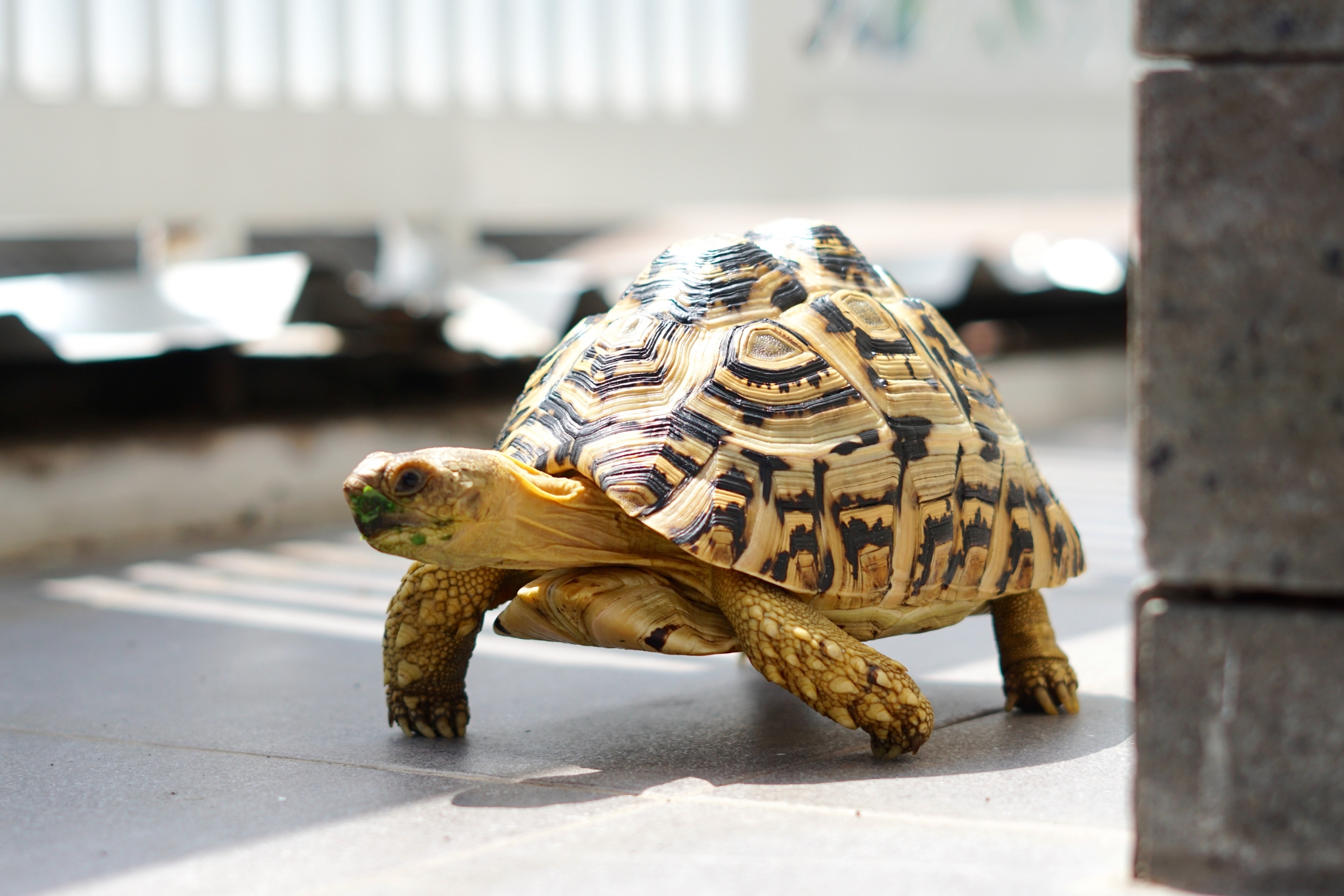
- Russian (Horsfield’s) Tortoises: naturally active and persistent—they’re well known for constant pacing in glass tanks
- Hermann’s Tortoises: more territorial by nature, making reflections and perceived “intruders” particularly stressful
- Greek (Spur-Thighed) Tortoises: active foragers that do best with clearly defined boundaries
- Sulcata (African Spurred) Tortoises: wide ranging animals that struggle in any small or transparent enclosure
The Bottom Line on Tortoise Tank Walls
A clear tank might look sleek in your space, but to your tortoise, it’s a constant source of confusion.
The issue isn’t something they can “learn” their way out of—it’s rooted in how tortoises are wired to perceive and navigate the world. Transparent barriers simply don’t register the same way solid ones do.
Switching to a solid walled enclosure is one of the most meaningful upgrades you can make for your tortoise’s long term health and comfort. When the environment makes sense, everything else starts to fall into place.
Your tortoise doesn’t need a panoramic view of your living room—they needs a space that feels safe and predictable. Think solid boundaries, deep substrate for burrowing, good airflow, and proper heat and light gradients. Provide those essentials, and you’ll likely notice a calmer, more settled buddy almost immediately.
Remember to always consult a veterinarian with reptile experience for guidance tailored to your specific species and setup.